

Barcelona buildings named after an architect, an artist and two writers: Mies, Tàpies, Arquimbau, García Márquez
Barcelona guide · Last checked Nov 25, 2026
Mies van der Rohe's name reaches three of the four stops in this guide: one is his own pavilion, and the other two are libraries he had nothing to do with, linked to him only through the architecture award named after him. The Pavelló Mies van der Rohe is his 1929 pavilion, rebuilt on the spot where it first stood. At the Fundació Antoni Tàpies, the artist's sculpture of a chair sticking out of a cloud sits on the roof of a publishing house that Lluís Domènech i Montaner drew. The Biblioteca Vila de Gràcia was designed by Josep Llinàs Carmona and Joan Vera i García and now carries the name of the writer Rosa M. Arquimbau. It was nominated for the EU Mies van der Rohe Award. The Biblioteca Gabriel García Márquez, designed by Elena Orte and Guillermo Sevillano of Suma Arquitectura, won that award's emerging architecture prize in 2024.
Pavelló Mies van der Rohe
Green marble, golden onyx quarried in the Atlas Mountains and Roman travertine make up the German Pavilion that Mies designed for the 1929 International Exposition. It was never meant to last, and it came down once the Expo was over. The architect Oriol Bohigas pressed for a rebuild in 1954, on the exhibition's 25th anniversary, and the copy on the original site was completed 32 years later.
The central partition inside is rust-coloured onyx. White travertine forms the plinth and the outer walls, and the chrome-plated steel columns have a cross-shaped section. Of the pavilion's two pools, Mies kept the bigger one free of sculpture. The smaller pool is walled in, across the site from the larger, and Georg Kolbe's bronze figure 'Alba' (Dawn) stands in it.
Since 1996 the Fundació Mies van der Rohe has invited artists to make temporary interventions in the building. Some of these artists have included Jeff Wall, SANAA, Spencer Finch, Sabine Marcelis and Ai Weiwei.
Address: Avenida de Francesc Ferrer i Guàrdia 7, 08038 Barcelona
Good to know: the six-language audioguide comes with entry. Listed as accessible for people with reduced mobility. It may shut or limit entry at short notice for events, or while an art intervention is being put up or taken down, so check the venue's listings for current times. A self-guided visit with the audioguide runs about 30 to 45 minutes.
Edifici Fundació Antoni Tàpies - Antiga Editorial Montaner i Simón
On the roof, a chair sticks out of a large cloud. It is Tàpies's Núvol i cadira (Cloud and Chair, 1990), and it can be seen from Carrer d'Aragó. It went up to add height to the building and to announce what the building had become.
Beneath it is the old Editorial Montaner i Simón, a publisher that Ramon Montaner and Francesc Simón set up in 1861. The commission went to Lluís Domènech i Montaner, nephew of one of the two founders, and he drew the plans in 1879. The front looks like a palace. Behind it he built a factory for making books, in exposed brick and iron, with the floors arranged around a courtyard framed by iron pillars.
Tàpies started the foundation in 1984. He moved it here in June 1990, once Roser Amadó and Lluís Domènech Girbau had converted the building. Much of its collection came as gifts from Antoni and Teresa Tàpies, and the foundation describes it as one of the most complete collections of his work. A second piece of his, Mitjó (Sock), a maquette from 1991, went onto the terrace during the 2008 to 2010 renovation. The publisher's fittings are still in use: the foundation's library fills the old warehouse and keeps books on the original Montaner i Simón shelving.
Good to know: the museum closed for renovation to improve the entrance and make the building more accessible, and its sources disagree on when it reopens, so check its own listings before going; in the meantime its activities run in other spaces. Núvol i cadira, on the roof, can be seen from Carrer d'Aragó.
Address: Carrer Aragó 255, 08007 Barcelona Getting there: about 42 minutes on foot from the pavilion
Biblioteca Vila de Gràcia - Rosa M. Arquimbau
In 2024 this became one of six libraries in the city network renamed after women; until then it had taken its name only from the neighbourhood. Its namesake, Rosa Maria Arquimbau Cardil (1909 to 1992), was a Catalan journalist and comic playwright who also wrote fiction. She published her first book, Tres contes breus, in 1928, and the Teatre Romesco put on her plays.
The plot would usually hold a block of flats, but here the street front swells outwards in stages so that what goes on inside is on show to the street. Josep Llinàs Carmona and Joan Vera i García designed it, and it went up between 2000 and 2002. It was nominated for the EU Mies van der Rohe Award and made the architecture final of the FAD Awards.
African cultures are the library's specialism, with a collection and a programme of activities devoted to the continent. The neighbourhood's own past sits on the third floor, where the librarian responsible for the Gràcia local collection runs an information desk. That collection runs from old local magazines such as Or i Flama and Des del Nord to posters, programmes and photographs of the district's streets, squares and Festa Major.
Address: Carrer del Torrent de l'Olla 104, 08012 Barcelona
Good to know: most of the local collection can be borrowed with a library card, and the building is listed as accessible for people with physical disabilities.
Getting there: about a 19-minute walk from the Tàpies building
Biblioteca Gabriel García Márquez
From outside, the six storeys look like books piled on top of each other, in wood and glass. Its collection centres on Latin American literature, which is the writer's link to the building. Elena Orte and Guillermo Sevillano of Suma Arquitectura designed it, and it first opened its doors in May 2022.
It holds the 2024 EU Mies van der Rohe Award for emerging architecture, alongside the Premi Ciutat de Barcelona d'Arquitectura and a 2023 FAD award. At its 2023 congress in Rotterdam, IFLA (the International Federation of Library Associations and Institutions) named it the world's best new public library, and no library in Spain had won that award before.
Wood covers the floors and walls. There are few doors or internal walls, so translucent screens divide the work areas, and there are hammocks, rugs in warm colours, a patio and terraces, along with a sensory room that works with sound, light and vibration.
No other library in Barcelona has a radio and podcast studio, and this one calls its studio Radio Macondo. Francisco Ibáñez, who created Mortadelo y Filemón, lived in the neighbourhood, and the library keeps a comics collection devoted to him.
Address: Plaça Carmen Balcells Segalà 1, 08020 Barcelona
Good to know: a silent reading room in the basement adds about 50 study places, and the library is full most days with people studying and reading.
Getting there: about 63 minutes on foot from the Gràcia library
Taken in order, the names move from an architect on his own building, to an artist on a publishing house drawn by Domènech i Montaner, to two writers on libraries designed by other people. The materials shift along the way too, from the pavilion's marble, onyx and travertine to the publisher's exposed brick and iron, and finally to a library of wood and glass stacked like books.
In this guide
Green marble, golden onyx quarried in the Atlas Mountains and Roman travertine make up the German Pavilion that Mies designed for the 1929 International Exposition. It was never meant to last, and it came down once the Expo was over. The architect Oriol Bohigas pressed for a rebuild in 1954, on the exhibition's 25th anniversary, and the copy on the original site was completed 32 years later. The central partition inside is rust-coloured onyx. White travertine forms the plinth and the outer walls, and the chrome-plated steel columns have a cross-shaped section. Of the pavilion's two pools, Mies kept the bigger one free of sculpture. The smaller pool is walled in, across the site from the larger, and Georg Kolbe's bronze figure 'Alba' (Dawn) stands in it. Since 1996 the Fundació Mies van der Rohe has invited artists to make temporary interventions in the building. Among those who have taken it on: Ai Weiwei, SANAA, Jeff Wall, Spencer Finch and Sabine Marcelis. Good to know: the six-language audioguide comes with entry. Listed as accessible for people with reduced mobility. It may shut or limit entry at short notice for events, or while an art intervention is being put up or taken down, so check the venue's listings for current times. A self-guided visit with the audioguide runs about 30 to 45 minutes.
In 2024 this became one of six libraries in the city network renamed after women; until then it had taken its name only from the neighbourhood. Its namesake, Rosa Maria Arquimbau Cardil (1909 to 1992), was a Catalan journalist and comic playwright who also wrote fiction. She published her first book, Tres contes breus, in 1928, and the Teatre Romesco put on her plays. The plot would usually hold a block of flats, but here the street front swells outwards in stages so that what goes on inside is on show to the street. Josep Llinàs Carmona and Joan Vera i García designed it, and it went up between 2000 and 2002. It was nominated for the EU Mies van der Rohe Award and made the architecture final of the FAD Awards. African cultures are the library's specialism, with a collection and a programme of activities devoted to the continent. The neighbourhood's own past sits on the third floor, where the librarian responsible for the Gràcia local collection runs an information desk. That collection runs from old local magazines such as Or i Flama and Des del Nord to posters, programmes and photographs of the district's streets, squares and Festa Major. Good to know: most of the local collection can be borrowed with a library card, and the building is listed as accessible for people with physical disabilities.
From outside, the six storeys look like books piled on top of each other, in wood and glass. Its collection centres on Latin American literature, which is the writer's link to the building. Elena Orte and Guillermo Sevillano of Suma Arquitectura designed it, and it first opened its doors in May 2022. It holds the 2024 EU Mies van der Rohe Award for emerging architecture, alongside the Premi Ciutat de Barcelona d'Arquitectura and a 2023 FAD award. At its 2023 congress in Rotterdam, IFLA (the International Federation of Library Associations and Institutions) named it the world's best new public library, and no library in Spain had won that award before. Wood covers the floors and walls. There are few doors or internal walls, so translucent screens divide the work areas, and there are hammocks, rugs in warm colours, a patio and terraces, along with a sensory room that works with sound, light and vibration. No other library in Barcelona has a radio and podcast studio, and this one calls its studio Radio Macondo. Francisco Ibáñez, who created Mortadelo y Filemón, lived in the neighbourhood, and the library keeps a comics collection devoted to him. Good to know: a silent reading room in the basement adds about 50 study places, and the library is full most days with people studying and reading. Taken in order, the names move from an architect on his own building, to an artist on a publishing house drawn by Domènech i Montaner, to two writers on libraries designed by other people. The materials shift along the way too, from the pavilion's marble, onyx and travertine to the publisher's exposed brick and iron, and finally to a library of wood and glass stacked like books.
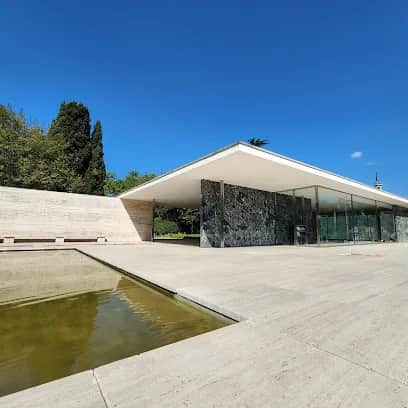
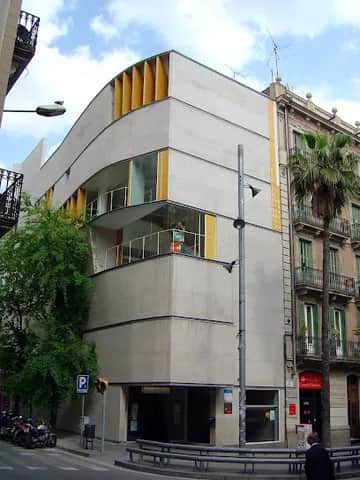
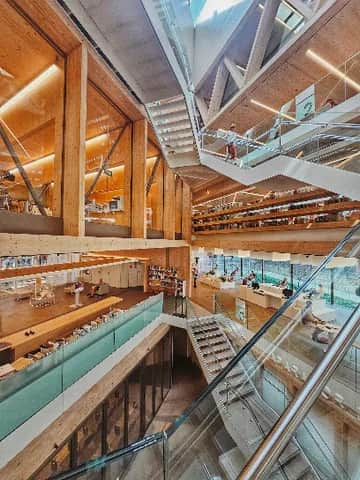
Photo and data credits
Frequently asked questions
Whose name does each building carry, and who designed it?
Pavelló Mies van der Rohe: named after and designed by Mies van der Rohe. Fundació Antoni Tàpies: named after the artist Antoni Tàpies, in a publishing house designed by Lluís Domènech i Montaner. Biblioteca Vila de Gràcia - Rosa M. Arquimbau: named after the writer Rosa M. Arquimbau, designed by Josep Llinàs Carmona and Joan Vera i García. Biblioteca Gabriel García Márquez: named after the writer Gabriel García Márquez, designed by Elena Orte and Guillermo Sevillano of Suma Arquitectura.
Which Barcelona building did Mies van der Rohe design?
The Pavelló Mies van der Rohe. He designed it as the German Pavilion for the 1929 International Exposition. It was taken down after the Expo; the architect Oriol Bohigas pressed for a rebuild in 1954, and the copy on the original site was completed 32 years later.
Who designed the Fundació Antoni Tàpies building?
Lluís Domènech i Montaner. He drew the plans in 1879 for the Editorial Montaner i Simón publishing house. Roser Amadó and Lluís Domènech Girbau later converted it for the foundation, which moved there in June 1990.
What is the sculpture on the roof of the Tàpies foundation?
Núvol i cadira (Cloud and Chair, 1990) by Antoni Tàpies, a chair sticking out of a large cloud. It can be seen from Carrer d'Aragó.
Who was Rosa M. Arquimbau, and why is a Gràcia library named after her?
Rosa Maria Arquimbau Cardil (1909 to 1992) was a Catalan journalist and comic playwright who also wrote fiction. In 2024 the Biblioteca Vila de Gràcia took her name, as one of six city network libraries renamed after women.
Why is a Barcelona library named after Gabriel García Márquez?
The Biblioteca Gabriel García Márquez centres its collection on Latin American literature. The building, designed by Suma Arquitectura, won the 2024 EU Mies van der Rohe Award for emerging architecture, and in 2023 IFLA named it the world's best new public library.
