

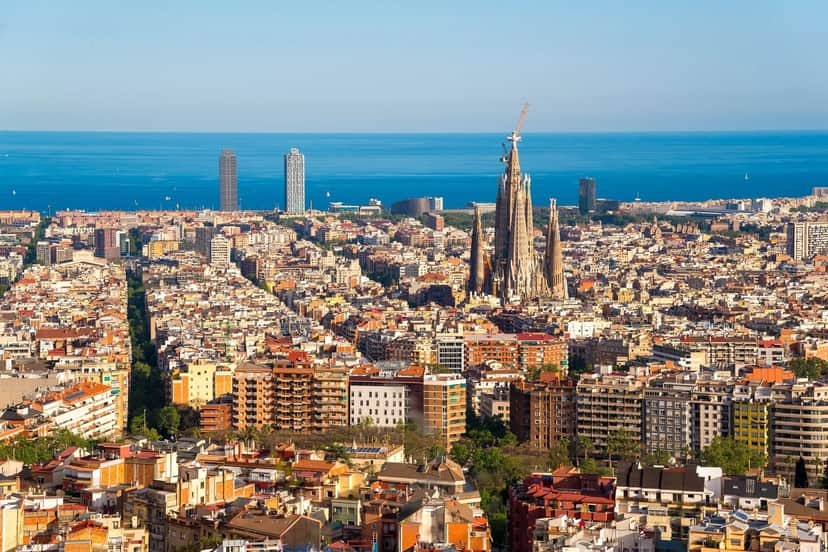
Barcelona for first-time visitors: transport, language and eating
Barcelona guide · Last checked Nov 24, 2026
Arriving from the airport
Barcelona-El Prat Airport lies about 15 km south-west of the centre. The metro serves both terminals, but that ride needs a separate airport ticket. A commuter train and the Aerobús, a private bus line with its own fares, also run into town.
How far you can walk
The centre is easy on foot: a grid in the Eixample, medieval lanes in the old city. Plaça de Catalunya, the square at the top of La Rambla, is 25 to 30 minutes (about 2 km) from the beach at Barceloneta. Park Güell, Antoni Gaudí's park on the hillside, is some 4.5 km and 55 minutes away, mostly uphill. Watch for bikes and electric scooters on the pavement, some of them riding there illegally.
Metro and buses
Transports Metropolitans de Barcelona (TMB) runs most of the metro and buses. The twelve metro lines are named L plus a number, each with its own colour. Trains have air conditioning; most stations don't, and in summer you feel it. The whole city is fare zone 1, so a T-casual card covers your trips.
Bus names give the direction. H lines run along the coast, V lines go from the beach up toward the hills, and D lines cut across at an angle. Almost all night lines stop at Plaça de Catalunya, the place to change after dark.
Pickpockets work lines L3 and L4 and the busy interchanges at Plaça de Catalunya and Passeig de Gràcia, mostly after wallets and passports.
The old city and La Rambla
Ciutat Vella, the old city, covers the Barri Gòtic, El Born and El Raval. Many buildings in the Barri Gòtic are medieval, a few are Roman, and the Roman street plan still shows. The Gothic cathedral, with its cloister, is here.
La Rambla is a tree-lined pedestrian street, 1.2 km long, running down from Plaça de Catalunya to the Columbus Monument at Port Vell. It is really several streets in a row, each with its own Rambla name. Crowds are thick and petty theft is common. A betting game on a cardboard box is a scam aimed at tourists.
Where to eat
- El Born (La Ribera): tapas bars, bakeries and modern Catalan cooking near the Santa Caterina Market.
- Gràcia: independent places and Catalan bistros, with terraces in its squares.
- Poble-Sec: Carrer de Blai, crowded with pintxo and tapas bars.
- Eixample: upmarket restaurants, old and new styles, and Modernista cafés.
How Catalans eat
Lunch begins around 2 pm; dinner rarely before 9. Many start with a vermouth or beer and some olives or crisps before lunch ("fer el vermut"). Look for pa amb tomàquet (bread rubbed with tomato, garlic and oil), the meat stew escudella i carn d'olla, calçots with romesco in winter and early spring, the fish stew suquet de peix, and crema catalana.
Smoking indoors in bars and restaurants has been banned since 2011; terraces usually allow it.
Language
Catalan and Spanish are both official. Catalan is its own language, not a dialect. It is the City Council's main language, and every place name, metro stops included, is in Catalan only. Spanish is what most people speak, and almost everyone understands it. Tourism staff mostly speak English, and a "bon dia" or "gràcies" is welcome.
When to go, and when shops shut
April, May, September and October suit sightseeing best. June to August is hot, humid and crowded, with August highs averaging about 28 °C. From December to February daytime highs average about 14 °C, with fewer visitors. The La Mercè festival is in late September, and September to November is the wettest stretch.
Many neighbourhood shops and restaurants close for two or three weeks in August, often around the 15 August holiday. Most shops close on Sundays and public holidays, except that from 15 May to 15 September shops in the central tourist zone may open on those days from noon to 8 pm; Maremagnum at Port Vell may open all year. Department stores such as El Corte Inglés stay open over lunch, while many small shops close for a midday break.
Photo and data credits
Frequently asked questions
How long does it take to walk across Barcelona?
Walking from Port Vell on the waterfront to Park Güell takes a little over an hour, passing La Rambla and Sagrada Família on the way.
What is the best time of year to visit Barcelona?
Temperatures of 19 to 23 °C are comfortable given the humidity, and they usually occur from May to June and from late August to October.
Do I need to speak Catalan in Barcelona?
No. Catalan and Spanish are both official languages, and in tourist areas almost all shops and bars have some English-speaking staff. Most signs are in Catalan only.
Should I rent a car in Barcelona?
Public transport reaches all the major areas and should be your main way of getting around. Driving brings traffic jams, very narrow streets in places and a complicated road system.
