

Buildings to see in Barcelona: an arch, the Mies pavilion, an ateneu and a wooden library
Barcelona guide · Last checked Nov 24, 2026
Among the buildings to see in Barcelona, the Pavelló Mies van der Rohe was designed by Mies for the 1929 International Exposition, taken down when the fair ended, and rebuilt on the same ground, with the rebuild completed in 1986. The Centre Sant Pere Apòstol has kept its doors open as a neighbourhood ateneu since 1892. The Arc de Triomf was the front gate of the 1888 Universal Exhibition. And the Biblioteca Gabriel García Márquez, opened in 2022, was the first public building in the city made wholly from wood.
Pavelló Mies van der Rohe
A single wall of rust-coloured onyx divides the interior. That onyx was quarried in the Atlas Mountains, and around it the pavilion uses green marble and Roman travertine. The travertine is white on the plinth and the outside walls, and the steel columns holding up the roof are chrome-plated and cross-shaped in section.
Water takes up much of the site. Of the two pools, Mies kept the bigger one bare and set the bronze figure, Georg Kolbe's "Alba" (Dawn), in the smaller one, walled in at the far end.
The pavilion was never meant to last. It came down after the Expo, and Oriol Bohigas began pushing for a rebuild in 1954, when the exhibition turned 25. Since 1996, the Fundació Mies van der Rohe has asked artists to alter it for short periods; Ai Weiwei, SANAA, Jeff Wall, Spencer Finch and Sabine Marcelis have all done so. Whether an artist's intervention is in place on a given visit can vary, so it is worth checking the pavilion's own listings before going.
Address: Avenida de Francesc Ferrer i Guàrdia 7, 08038 Barcelona
Step-free for people with reduced mobility; access can close or be restricted at short notice for events. An audioguided visit runs about 30 to 45 minutes.
Centre Sant Pere Apòstol
Each winter the centre's own amateur company, GESPA, more than a hundred members strong, puts on Pitarra's Pastorets, "El bressol de Jesús o en Garrofa i en Pallanga", on its home stage. That stage is the Teatre Gespa, and the building also contains a second hall, the Auditori Cullell i Fabra.
The history of this centre begins in the year 1892. It has received both the Creu de Sant Jordi of the Catalan Government and the Medalla d'Honor of the city of Barcelona. It is a member of the Federació d'Ateneus de Catalunya.
Beyond the Pastorets, the programme runs from sardanes and choirs to a musical bingo. What draws people through these doors is what goes on inside them, so the centre's current listings decide what the evening is.
Address: Carrer de Sant Pere Més Alt 25, 08003 Barcelona
The theatre is listed as accessible for people with physical disabilities. The café-bar is at the centre's other site, not here.
Getting there: about 48 minutes on foot from the pavilion, so a taxi or public transport is the easier option.
Arc de Triomf
Carved stone bats sit on both of the arch's pillars, a nod to King Jaume I, whose emblem was the bat. Josep Vilaseca i Casanovas built the whole thing in red brick in the neo-Mudéjar manner, roughly 30 m high, and it celebrates progress in the arts, science and trade rather than a war won.
The closer the look, the more ceramic there is. Green and yellow glazed tiles with plant patterns run round the base, glazed ceramic in earth tones fills the corners of the wall on either side of the arch's curve, and yellow star shapes are set into the cornice. On top, eight brick domes covered in green and yellow ceramic each carry an oversized glazed count's crown.
A laurel wreath carved in stone circles the arch, carrying the arms of every one of the 49 provinces Spain had in 1888, and Barcelona's own arms, bigger than the rest, sit at the very top of the curve, dead centre. Two of the stone friezes are Josep Reynés's "Barcelona welcomes the nations" and Josep Llimona's "Recompense". After dark falls the brick is floodlit, and dusk is the time to see it red.
Address: Passeig de Lluís Companys, 08003 Barcelona
Open public space, no ticket needed. The friezes may be partly behind protective netting put up to catch falling fragments. Early morning tends to be quietest.
Getting there: about an 8-minute walk from Centre Sant Pere Apòstol.
Biblioteca Gabriel García Márquez
From the street, the six storeys look like a pile of books, put together in wood and glass by Suma Arquitectura, the practice of Elena Orte and Guillermo Sevillano. Inside, the floors and walls are timber, there are hardly any doors or partitions, and the reading areas are separated by see-through screens, with hammocks, warm-toned rugs, a patio and terraces.
At its 2023 congress in Rotterdam, IFLA, the International Federation of Library Associations and Institutions, named it the best new public library in the world, a first for any library in Spain. Architecture juries followed: the Premi Ciutat de Barcelona d'Arquitectura, a FAD award and the 2024 EU Mies van der Rohe Award for emerging architecture.
What is on the shelves belongs to this neighbourhood. The main collection is Latin American literature. Francisco Ibáñez, who created Mortadelo y Filemón, lived nearby, and a comics collection is given over to his work. Alongside it are a local-history collection on Sant Martí de Provençals and La Verneda, a sensory room using sound, light and vibration, and Radio Macondo, a radio and podcast studio that no other Barcelona library has.
The director says every day the seats fill with people studying, reading and meeting for reading clubs.
Address: Plaça Carmen Balcells Segalà 1, 08020 Barcelona
Saturdays are the busiest days. For quiet, a basement silent room has around 50 study places.
Getting there: about 54 minutes on foot from the Arc de Triomf, so a taxi or public transport is the easier option.
Two of these buildings were made for exhibitions, the pavilion for 1929 and the arch for 1888, and each of the four has a detail worth looking for: a bronze Dawn walled into the pavilion's smaller pool, stone bats on the arch's pillars, a winter Pastorets on the ateneu's stage, a radio studio among the library's shelves. And the walk comes full circle at the library, whose 2024 award for emerging architecture carries the name of Mies, the architect whose pavilion had to be built twice.
In this guide
A single wall of rust-coloured onyx divides the interior. That onyx was quarried in the Atlas Mountains, and around it the pavilion uses green marble and Roman travertine. The travertine is white on the plinth and the outside walls, and the steel columns holding up the roof are chrome-plated and cross-shaped in section. Water takes up much of the site. Of the two pools, Mies kept the bigger one bare and set the bronze figure, Georg Kolbe's "Alba" (Dawn), in the smaller one, walled in at the far end. The pavilion was never meant to last. It came down after the Expo, and Oriol Bohigas began pushing for a rebuild in 1954, when the exhibition turned 25. Since 1996, the Fundació Mies van der Rohe has asked artists to alter it for short periods; Ai Weiwei, SANAA, Jeff Wall, Spencer Finch and Sabine Marcelis have all done so. Whether an artist's intervention is in place on a given visit can vary, so it is worth checking the pavilion's own listings before going. Step-free for people with reduced mobility; access can close or be restricted at short notice for events. An audioguided visit runs about 30 to 45 minutes.
From the street, the six storeys look like a pile of books, put together in wood and glass by Suma Arquitectura, the practice of Elena Orte and Guillermo Sevillano. Inside, the floors and walls are timber, there are hardly any doors or partitions, and the reading areas are separated by see-through screens, with hammocks, warm-toned rugs, a patio and terraces. At its 2023 congress in Rotterdam, IFLA, the International Federation of Library Associations and Institutions, named it the best new public library in the world, a first for any library in Spain. Architecture juries followed: the Premi Ciutat de Barcelona d'Arquitectura, a FAD award and the 2024 EU Mies van der Rohe Award for emerging architecture. What is on the shelves belongs to this neighbourhood. The main collection is Latin American literature. Francisco Ibáñez, who created Mortadelo y Filemón, lived nearby, and a comics collection is given over to his work. Alongside it are a local-history collection on Sant Martí de Provençals and La Verneda, a sensory room using sound, light and vibration, and Radio Macondo, a radio and podcast studio that no other Barcelona library has. The director says every day the seats fill with people studying, reading and meeting for reading clubs. Saturdays are the busiest days. For quiet, a basement silent room has around 50 study places. Two of these buildings were made for exhibitions, the pavilion for 1929 and the arch for 1888, and each of the four has a detail worth looking for: a bronze Dawn walled into the pavilion's smaller pool, stone bats on the arch's pillars, a winter Pastorets on the ateneu's stage, a radio studio among the library's shelves. And the walk comes full circle at the library, whose 2024 award for emerging architecture carries the name of Mies, the architect whose pavilion had to be built twice.
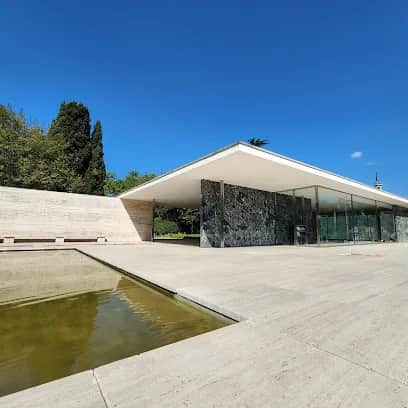
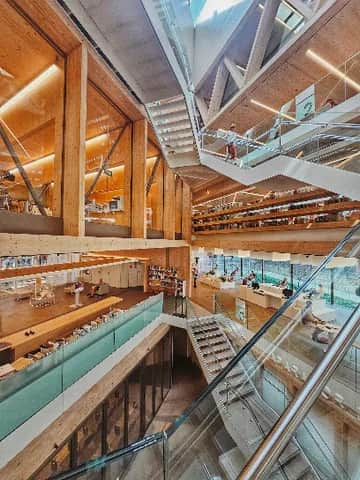
Photo and data credits
Frequently asked questions
Who designed the Arc de Triomf in Barcelona?
Josep Vilaseca i Casanovas designed it in red brick, in a neo-Mudéjar style, as the main gateway to the 1888 Universal Exhibition.
Do you need a ticket to see the Arc de Triomf?
No. It stands in an open public space. At dusk the brick is lit up.
Is the Barcelona Pavilion the original 1929 building?
No. The German Pavilion was taken down after the 1929 International Exposition and rebuilt on its original site, with the work completed in 1986.
How long does a visit to the Mies van der Rohe Pavilion take?
With the audioguide, about 30 to 45 minutes.
Why is the Biblioteca Gabriel García Márquez famous?
In 2023 IFLA named it the world's best new public library, the first library in Spain to win the award. It was also Barcelona's first public building made wholly from wood.
What is on at the Centre Sant Pere Apòstol?
Theatre, sardanes, concerts and choirs, dramatised readings and talks, plus a Pastorets staged every year by its amateur company, GESPA. The centre's current listings give dates.
