

The Barcelona Pavilion: what Mies van der Rohe's building is
Barcelona guide · Last checked Nov 24, 2026
The Barcelona Pavilion that Mies van der Rohe designed as Germany's pavilion for the 1929 International Exposition came down when the Expo ended, and the one standing now is a reconstruction completed on the same site in 1986.
Pavelló Mies van der Rohe
Why there is a pavilion to visit
The architect Oriol Bohigas argued in 1954, the exhibition's 25th anniversary, that the pavilion should be rebuilt.
Stone, steel and water
Inside, the main dividing wall is made of book-matched slabs of warm, rust-toned onyx. The plinth and outer walls are in white travertine, and the steel columns have a cross-shaped section with a chrome finish. The palette also takes in green marble, and the onyx is a golden stone from the Atlas Mountains, while the travertine is Roman.
Water fills two basins. Mies put nothing in the larger of the two. Georg Kolbe's bronze 'Alba' (Dawn) went into the smaller one, which is walled in at the far side of the plot.
Art inside the pavilion
The Fundació Mies van der Rohe invites artists to make temporary works inside the pavilion, among them Ai Weiwei, SANAA, Jeff Wall, Spencer Finch and Sabine Marcelis. Ai Weiwei's piece was titled 'With Milk', and Marcelis's 2019 work was 'No Fear of Glass'. One of these works covered the travertine podium with a maze of laminated glass panes. That was 'Pavelló-Laberint' by Ciro Najle and Josep Ferrando, on show from 12 to 22 November 2026. For it, the pavilion closed from 2 to 11 November for installation, entry during the run was only with advance timed tickets, and the building is closed again from 23 to 27 November while the work is dismantled.
Visiting
Address: Avenida de Francesc Ferrer i Guàrdia 7, 08038 Barcelona
Before you go: The pavilion is described as accessible for people with reduced mobility, and it can close or restrict entry at short notice for events or while an art installation goes in or comes out, so check the venue's own listings first. A self-guided visit with the six-language audioguide takes about 30 to 45 minutes. Outside those closures it opens every day except 25 December, from 10:00 to 20:00 between March and October and from 10:00 to 18:00 between November and February, with last entry 15 minutes before closing. Under-16s go in free, and entry is free for everyone on the first Sunday of each month, with no reservation needed. Students, unemployed visitors and large or single-parent families qualify for a reduced rate, and a Pavilion Card gives a year of unlimited entry.
Mies meant all that onyx, travertine and chrome to stand for a single exhibition. Look at the onyx wall and at the larger basin he left with nothing in it, with that brief in mind: what you are standing in is the 1986 rebuild, on the same site, of a building made to be taken down.
In this guide
The architect Oriol Bohigas argued in 1954, the exhibition's 25th anniversary, that the pavilion should be rebuilt. Inside, the main dividing wall is made of book-matched slabs of warm, rust-toned onyx. The plinth and outer walls are in white travertine, and the steel columns have a cross-shaped section with a chrome finish. The palette also takes in green marble, and the onyx is a golden stone from the Atlas Mountains, while the travertine is Roman. Water fills two basins. Mies put nothing in the larger of the two. Georg Kolbe's bronze 'Alba' (Dawn) went into the smaller one, which is walled in at the far side of the plot. The Fundació Mies van der Rohe invites artists to make temporary works inside the pavilion, among them Ai Weiwei, SANAA, Jeff Wall, Spencer Finch and Sabine Marcelis. Ai Weiwei's piece was titled 'With Milk', and Marcelis's 2019 work was 'No Fear of Glass'. One of these works covered the travertine podium with a maze of laminated glass panes. That was 'Pavelló-Laberint' by Ciro Najle and Josep Ferrando, on show from 12 to 22 November 2026. For it, the pavilion closed from 2 to 11 November for installation, entry during the run was only with advance timed tickets, and the building is closed again from 23 to 27 November while the work is dismantled. Before you go: The pavilion is described as accessible for people with reduced mobility, and it can close or restrict entry at short notice for events or while an art installation goes in or comes out, so check the venue's own listings first. A self-guided visit with the six-language audioguide takes about 30 to 45 minutes. Outside those closures it opens every day except 25 December, from 10:00 to 20:00 between March and October and from 10:00 to 18:00 between November and February, with last entry 15 minutes before closing. Under-16s go in free, and entry is free for everyone on the first Sunday of each month, with no reservation needed.
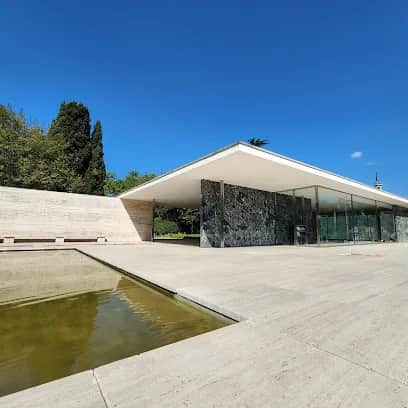
Photo and data credits
Frequently asked questions
What is the Barcelona Pavilion?
Mies van der Rohe designed it as the German Pavilion for the 1929 International Exposition in Barcelona. The building there today is a reconstruction on the original site, completed in 1986.
Is the Barcelona Pavilion the original building?
No. The 1929 pavilion was designed to be temporary and was taken down after the Expo. Oriol Bohigas called for it to be rebuilt in 1954, and the reconstruction was completed in 1986.
What materials is the Barcelona Pavilion made of?
A rust-coloured onyx wall forms the main interior partition, white travertine covers the plinth and outer walls, and the steel columns are cross-shaped and chrome-plated.
What is the statue in the Barcelona Pavilion?
Georg Kolbe's bronze 'Alba' (Dawn). It stands in the smaller of the pavilion's two water basins, in an enclosed court on the far side of the site. Mies put nothing in the larger basin.
How long does it take to visit the Barcelona Pavilion?
A self-guided visit with the audioguide takes about 30 to 45 minutes. The audioguide is available in six languages.
Is the Barcelona Pavilion wheelchair accessible?
The pavilion is described as accessible for people with reduced mobility. It can close or limit entry at short notice for events and art installations, so check the venue's own listings before going.
