Bordeaux's old centre: English rule, Atlantic trade and the 18th century
By Charmed Giraffe · Published Nov 21, 2026 · 3 min read
Most of the stone quays and squares in central Bordeaux went up in one century, the 18th, when its port was rich. In 2007 UNESCO listed the district around the Port of the Moon, more than a third of the city's surface, as World Heritage.
Three hundred years under the English crown
Eleanor, Duchess of Aquitaine, married Henry Plantagenet in 1152, and in 1154 he was crowned Henry II of England. Bordeaux and Aquitaine then stayed English for about three centuries. Henry let the city trade with England free of tax, and wine was what it sold.
The usual wine then was clairet, a deep pink wine still made today under the Bordeaux clairet appellation. The English took the name as "claret" and came to use it for any red from Bordeaux.
How the English era ended
The French won the Battle of Castillon in 1453, roughly 40 km east of the city, and Bordeaux passed to France. With its English buyers lost, the wine trade slumped.
The 18th-century boom and the slave trade
In the 18th century the port shipped coffee, cocoa, sugar, cotton and indigo to most of Europe, ahead of every French port and behind only London worldwide. The rebuilt centre later served Georges-Eugène Haussmann, once prefect here, as his model for remaking Paris.
Much of the money came from slavery. Bordeaux shipowners took 150,000 Africans across the ocean on some 500 voyages. That triangular run was only 5% of the city's wealth; the remaining 95% came from direct Caribbean trade in sugar, coffee and cocoa grown by enslaved people. When Saint-Domingue revolted and became Haiti in 1804, the port economy collapsed.
Older layers to look for
- Palais Gallien: ruins of a Roman amphitheatre from the late 2nd century, in a residential area north of the centre.
- Cathédrale Saint-André: consecrated in 1096 and rebuilt in Gothic style between the 12th and 15th centuries, with its Gothic bell tower, Tour Pey-Berland, standing on its own beside it.
- Grosse Cloche: a 15th-century gate in the medieval walls, once the old town hall's belfry, with two round towers 40 m high.
- Porte Cailhau: a gatehouse in the walls, put up in 1495 for Charles VIII's victory at Fornovo.
- Porte de Bourgogne: an 18th-century gate, built from 1751 to 1755 where a medieval gate stood.
- Place Gambetta: the square that Porte Dijeaux, a city gate built from 1748 to 1753, opens onto.
Walking the old centre
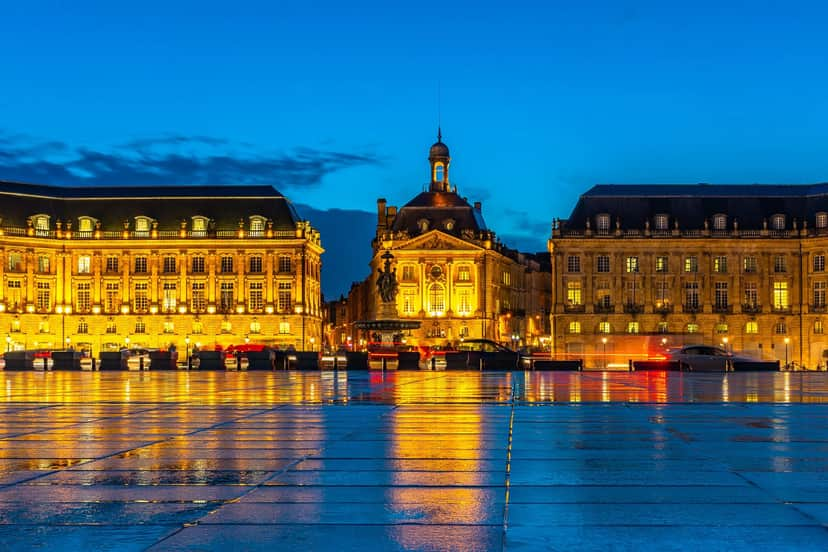
The quays curving along the Garonne's west bank make up the Port of the Moon. Eighteenth-century fronts line them south from Place des Quinconces, France's biggest square. Along the way are Place de la Bourse, laid out by Jacques Gabriel from 1735, and the Miroir d'eau, a shallow mirror pool.
Behind the quays sit Saint-Pierre, the medieval core of narrow lanes, and Saint-Michel, around its Gothic basilica. Chartrons, north along the river, was the wine merchants' quarter and now has antique shops.
Walking covers it. Many streets on the tram route became car-free when the tram opened, and lines B and C run along the river. Rue Sainte-Catherine, France's longest pedestrian street, runs 1.2 km from Place de la Victoire to Place de la Comédie.
For the slave trade, the Musée d'Aquitaine has four permanent rooms on it, and a plaque on the quays marks where the first slave ship sailed.
Photo and data credits
Frequently asked questions
How long was Bordeaux under English rule?
Bordeaux and the whole province of Aquitaine were under English rule for 300 years, starting in 1154, after the marriage of Eleanor of Aquitaine to the future King Henry II.
What happened to Bordeaux after 1453?
France took control of Aquitaine in 1453 and cut off the supply of wine to England. Bordeaux fell into a slump and revived from the 16th century through trans-Atlantic trade.
When were most of Bordeaux's fine buildings built?
Most of them were erected in the 18th century, when the city prospered.
Why has the 18th-century centre of Bordeaux been preserved?
Damage to buildings in later conflicts was small enough to be repaired rather than rebuilt on a large scale. The 18th-century grandeur was therefore preserved.