Cinema and theatre in Lisbon: the Cinemateca, the Tivoli and the Teatro Camões
By Charmed Giraffe · Published Nov 23, 2026 · 6 min read
Three houses, three kinds of evening. The Cinemateca Portuguesa, the state film archive, screens about a hundred films a month, from the original 35mm or 16mm print where one survives. The Tivoli on Avenida da Liberdade, five minutes' walk from the Cinemateca, began as a cinema in 1924; today its stage takes concerts, dance, comedy and visiting productions. The Teatro Camões, out by the river at Parque das Nações, is the home of the national ballet company.
Pick the Cinemateca for old and rare films, the Tivoli for a touring show in a hall from 1924, and the Camões for ballet with live music. Each publishes its own listings, and all three change their bill often.
Cinemateca Portuguesa
Who it suits: anyone who wants film history on a big screen, in the language it was made in.
What is on. The programme is built from cycles, each lasting a calendar month, and a dozen can overlap: a retrospective of one actor, the catalogue of one producer, silent films accompanied on piano, Saturday sessions for families. Cinemateca Júnior is the strand for younger viewers. The month's cycles come out as a PDF on cinemateca.pt. On an ordinary weekday there are three screenings in the main hall, which seats 227, and one in the Sala Luís de Pina, which seats 47. Over a year the two halls run roughly a thousand sessions for more than fifty thousand people.
What catches visitors out. Subtitles are electronic and in Portuguese only, never English, so pick films in a language you follow. Phone bookings are taken only from members of the Amigos da Cinemateca. Some sessions take no bookings at all: the box office hands out tickets on the day until the hall is full. For one of these the queue reached down to Avenida da Liberdade hours ahead, and dozens were turned away.
Summer. From mid-June, Monday to Saturday, films are shown on the open-air roof terrace, again undubbed and with Portuguese subtitles. The bar and restaurant up there is 39 Degraus: 39 steps lead to it, and the name winks at Hitchcock's The 39 Steps.
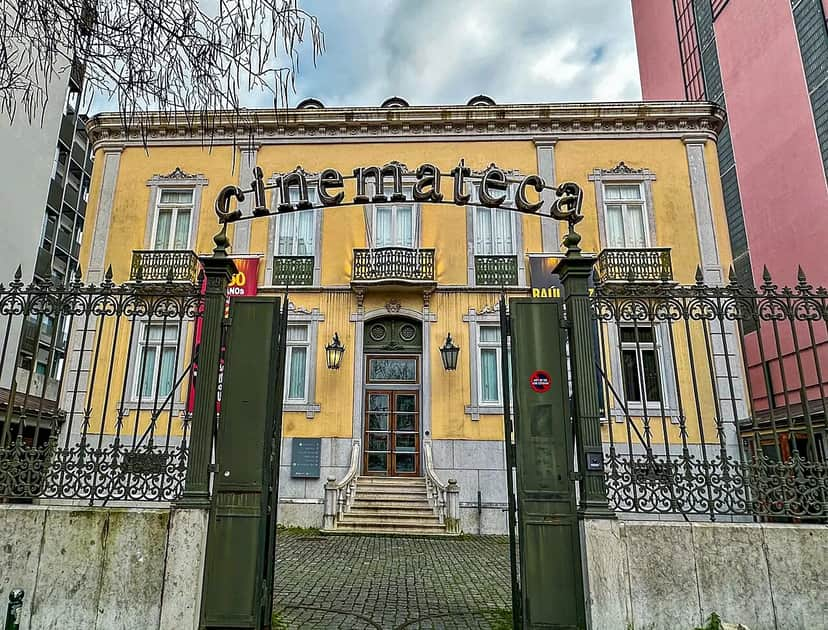
The building. The Cinemateca was set up in 1948, in the Estado Novo years, and joined the International Federation of Film Archives in 1956. Its home, in the Príncipe Real neighbourhood, is a villa built in 1887 for the family of the lawyer and politician Morais Carvalho, who kept it for almost a century until the state bought it in 1979. It is one of the few private villas left on a street that was still mostly houses in the 1960s. A cinema built in the old garden opened in 1980, burned the next spring and was back in use by 1982. Since then the house has gained two underground halls, a museum, a restaurant and a shop for film books and DVDs, with its facade untouched. Architects Alberto Castro Nunes and António Maria Braga restored the building in 2001 and 2002, and it reopened in December 2002. The two halls carry the names of Félix Ribeiro, the first director, and Luís de Pina.
Leave time for the exhibition rooms, named Carvalhos, Cupidos and 6x2, which keep their 1887 ceiling paintings of Cupids and Muses. The Cupid Room shows magic lanterns, and the Cinema Museum's other collections cover sound, lighting and pre-cinema devices.
Tivoli
Who it suits: visitors after a touring show, a concert or stand-up in a large period theatre.
What is on. Shows still go up here all the time: concerts by the Orquestra Metropolitana de Lisboa, theatre, dance, stand-up and touring productions. Visiting productions stay anything from several nights to several weeks, and the programme changes often. The 2026-27 season includes Stomp (23 February to 14 March 2027) and Slava's Snowshow (12-23 May 2027).
The building. Raul Lino designed it in a neoclassical style after French models, with a domed roof of black tiles. The emblem on the front is a bouquet of four roses, one for each daughter of the founder, Frederico Lima Mayer: Ana, Rita, Helena and Maria. It opened on 30 November 1924 with 1,114 seats; after a renovation in 1999 it holds 1,088. The European Film Academy names it one of its Treasures of European Film Culture, a list of about sixty places in Europe; it is the second Portuguese entry, after Porto's Ribeira.
Seeing inside without a show. Tasting Fado is the one way in. It runs from Wednesday to Saturday, early in the evening, and lasts under an hour: a ten-minute tour of the house, then five or six songs, served with port and a pastel de nata.
Tickets. Ticketline.pt sells at any hour. The box office shuts for all of August and opens again on 1 September, but Ticketline keeps selling. Seats for people with reduced mobility are not sold online: phone or email the box office for them.
Teatro Camões
Who it suits: ballet-goers, and anyone who wants a full evening of dance with an orchestra.
What is on. The Companhia Nacional de Bailado, founded in 1977, has run and programmed the theatre since 2003. Its season is split into cycles: new commissioned work under the name Nova Criação, pieces by established choreographers under Grandes Mestres, the classical repertoire with live orchestra, and tours to regional theatres between runs at home. A run here covers two weekends, with evening shows on Thursday and Friday, an early-evening show on Saturday and a matinee on Sunday. A full-length story ballet lasts about two hours, with two intervals and live music.
Booking. Book early: several dates of one nine-performance run sold out two days after the premiere. Galleries, boxes and seats with a restricted view are released only when every date of a run is sold out, so if you see them on sale, the other seats are gone. A ticket can be moved to another date as long as its own performance has not yet happened. Tickets are sold online at teatrocamoes.bol.pt, in BOL outlets and at the theatre's own counter, which takes cash, Multibanco or card; phone and email reservations need at least 48 hours' notice.
The building. Manuel Salgado and Marino Fei of Atelier Risco designed the theatre for Expo '98, and it opened in 1998 with O Corvo Branco, an opera by Philip Glass directed by Robert Wilson to a libretto by Luísa Costa Gomes. The architects had drawn an extra wing meant for the national symphony orchestra, but the ballet company moved in, and the building has served for its daily rehearsals as well. Blue metal sheeting over white concrete wraps the stage tower, and the concrete carries on into the paving outside. The foyer looks onto the Tagus through a large glazed front called Mar da Palha. The auditorium has 873 seats in petrol blue, matching the cladding.
Getting there. On foot from the Tivoli it is well over an hour, so take a taxi or public transport. Gare do Oriente, the station for trains, metro, buses and taxis in Parque das Nações, is the stop to aim for; the theatre is beside the Oceanário.
Photo and data credits
Frequently asked questions
Are films at the Cinemateca Portuguesa subtitled in English?
No. Subtitles are electronic and in Portuguese only, never English, so pick films in a language you follow.
How does the Cinemateca Portuguesa publish its programme?
The month's cycles come out as a PDF on cinemateca.pt. Each cycle lasts a calendar month, and a dozen can overlap.
Can you visit the Tivoli without a show ticket?
Tasting Fado is the one way in. It runs Wednesday to Saturday, early in the evening, and lasts under an hour: a ten-minute tour of the house, then five or six songs, served with port and a pastel de nata.
Can reduced-mobility tickets for the Tivoli be bought online?
No. Seats for people with reduced mobility are not sold online: phone or email the box office for them.
When does the Companhia Nacional de Bailado perform at Teatro Camões?
A run covers two weekends, with evening shows on Thursday and Friday, an early-evening show on Saturday and a matinee on Sunday. The season is split into cycles, with tours to regional theatres between runs at home.
How far is Teatro Camões from the Tivoli?
Well over an hour on foot, so take a taxi or public transport to Gare do Oriente; the theatre is beside the Oceanário. The Cinemateca and the Tivoli are five minutes' walk apart.
Does the Cinemateca Portuguesa show films outdoors?
Yes. From mid-June, Monday to Saturday, films are shown on the open-air roof terrace, undubbed and with Portuguese subtitles.