Manhattan's uptown and downtown grid and the subway lines that run through it
By Charmed Giraffe · Published Nov 21, 2026 · 5 min read
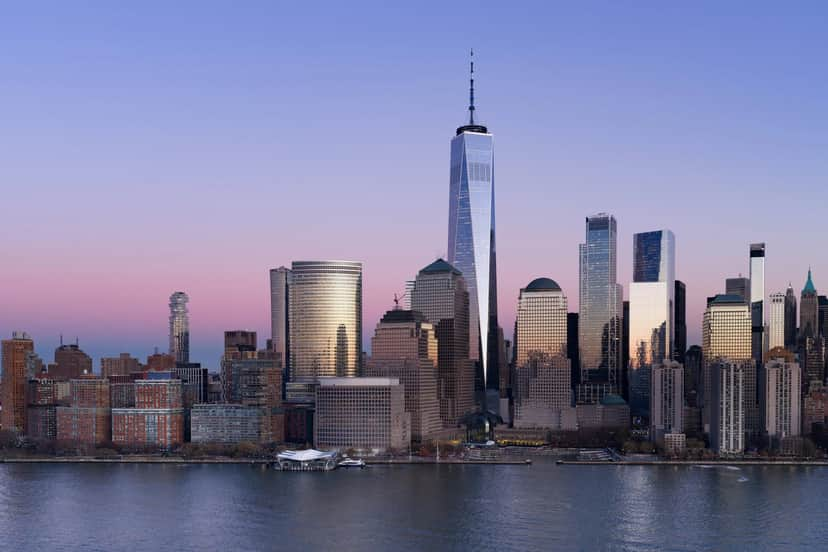
Manhattan's grid goes back to the Commissioners' Plan of 1811, which laid streets over almost the whole island. Streets cross it east to west and their numbers get bigger as you head north; avenues run roughly south to north. New Yorkers call north "uptown" and south "downtown". The grid sits about 29 degrees east of true north, so uptown really means north-northeast and downtown south-southwest.
The subway opened on October 27, 1904, has 423 stations, and nearly all of it runs 24 hours a day. What follows is how to pick the right entrance, the right train and the right platform.
Check the entrance first
Read the sign over the stairs before you go down. It tells you which direction the trains below are heading, and at stations where only local trains stop, an entrance can lead to one platform only. If it is the wrong way, cross the street and use the entrance on the far side.
A green globe on top of the stair railings marks an entrance open at all hours. At the turnstile, tap a contactless bank card, a phone wallet such as Apple Pay or Google Pay, or an OMNY card.
Express or local
The main lines through Manhattan have four tracks side by side. Local trains use the two outer tracks and stop at every station; express trains use the two inner ones and skip the smaller stations, so they get you farther faster. Any line with an express also has a local doing every stop.
At an express station, the local and express tracks usually face each other across one island platform, so you can change between them by crossing the platform, without paying again or using stairs. Take an express by mistake and it will carry you past your neighbourhood: get off at the next express stop and ride a local back.
Service changes after dark and at weekends. Some expresses switch to local or stop running late at night, and a few lines run express only at rush hour, in the busy direction. At weekends and late at night, some routes are suspended or cut short, many expresses call at local stations, and some entrances close.
A worked example: the 1, 2 and 3
The IRT Broadway–Seventh Avenue Line carries three numbered trains. North of 42nd Street it runs under Broadway; south of it, under Seventh Avenue. Within Manhattan the 1 is the stopping train and the 2 and 3 are expresses; beyond it, the 2 carries on into the Bronx and Brooklyn, and the 3 into Brooklyn.
The 1 stops everywhere from South Ferry, where you can catch the ferry, up the West Side and into the Bronx, including 116th Street for Columbia University. From 96th Street down to Chambers Street, the 2 and 3 skip the local stations. That is the trap: wait at 79th Street or 86th Street for a 2 or 3 and none will stop, because only the 1 calls there.
Late at night the 1 and 2 both run local, and the 3 comes no farther south than 34th Street–Penn Station.
More lines with an express and a local
- Eighth Avenue Line, trains A, C and E. It runs under Eighth Avenue and Central Park West from 14th to 116th Street, and from 125th Street in Harlem follows St. Nicholas Avenue, Broadway and Fort Washington Avenue. In Manhattan the A is the express and the C and E are locals, except late at night. In Queens the E runs express, which makes it the train from Midtown for Jamaica and JFK. Overnight there is no C, and the A stops at every station from Upper Manhattan to Rockaway.
- Sixth Avenue Line, trains B, D, F and M. It follows Sixth Avenue from West 4th Street up to 47th–50th Streets. The B and D run express, the F and M are locals, and the B runs on weekdays only, not late at night; at weekends and late at night the M does not run on this line.
- Broadway Line, trains N, Q, R and W. It runs under Broadway south of 42nd Street, then past Times Square along Seventh Avenue and 59th Street. The Q is the express, the R and W the locals. The N is express on weekdays and local at weekends and late at night, and late at night the Q runs local too.
- Lexington Avenue Line, with the 4, 5 and 6. The 4 and 5 are expresses, the 6 the local. Through the night the 5 is cut back to a shuttle within the Bronx, while 4 and 6 trains both use the local tracks.
Lines with little or no express running
- The 7 (Flushing Line) crosses Manhattan along 42nd Street and heads into Queens. It is the only train on that line, but at rush hour it runs express in the busy direction: into Manhattan in the morning, out to Flushing in the evening.
- The J and Z (Nassau Street Line) start at Broad Street, go up Nassau Street in Lower Manhattan, then cross into Brooklyn along Broadway and Fulton Street and end in Jamaica, Queens. The J mostly runs local, but on weekdays it runs express between Myrtle Avenue and Marcy Avenue: toward Manhattan until early afternoon, away from it after that. The Z only runs at rush hour, as a skip-stop train.
- The L (Canarsie Line) crosses Manhattan on 14th Street and continues through Williamsburg and Bushwick to Canarsie, Brooklyn.
- The S (42nd Street Shuttle) shuttles back and forth, with Times Square at its west end and Grand Central Terminal at its east end.
On the L and the shuttle, every train makes every stop, so there is no express to wait for.
Missed your stop?
Stay on the train: do not walk between the cars or pull the emergency brake unless there is a real safety hazard. At the next station, step off, but do not go out through the turnstiles to the street. Follow the signs to the platform for the opposite direction; at many stations a mezzanine or a passage under the tracks takes you there without paying again. Where the two platforms do not connect, ask a station worker which stop ahead lets you change sides, ride there and switch. The countdown clocks on the platform, or a transit app fed by MTA data, will confirm which side takes you back.
Photo and data credits
Frequently asked questions
What do "uptown" and "downtown" mean in Manhattan?
In Manhattan, "uptown" and "north" mean northeast, while "downtown" and "south" mean southwest.
Do street numbers rise as you go uptown?
Yes, street numbers rise as one moves farther uptown in Manhattan.
Which train is express on the Broadway and 7th Avenue Line in Manhattan?
On the Broadway and 7th Avenue Line in Manhattan, the 2 and 3 are express and the 1 runs local, though late at night the 1 and 2 run local and the 3 turns around at 34th Street and Penn Station.
How do I know which direction a subway train is heading before I go down?
Signs outside the entrance show which direction the trains from that entrance head toward.
Do express trains run at all hours?
No, some express trains run local or do not run at all late at night, and some express trains operate only during rush hour in one direction.
What should I do if I miss my subway stop?
Get off at the next station, do not go out to the street, and navigate underground to the opposite platform following the signs.