

A Street-Art Walk in Lisbon
Lisbon guide · Last checked Nov 23, 2026
Seven murals over 3.7 km: up from Martim Moniz into Graça, along two mural streets at the top, then down through Alfama to Santa Apolónia by the river. The walls are by Shepard Fairey, Vhils and Bordalo II, with AkaCorleone, Add Fuel, OzeArv and Daniel Eime making up the seven. The opening climb is the hardest stretch, on steep cobbles and stone steps. Wear shoes that grip, and in summer carry water: the heat makes the climb at midday exhausting.
Murals here come and go. Many of Vhils's Lisbon pieces are reported to have vanished already, among them the large face on Avenida da Índia, demolished in 2018. All seven walls on this route were recorded as still there in September 2026. Check before you set out.
Martim Moniz and the climb
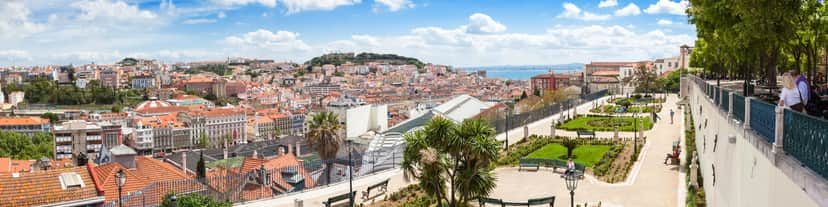
Praça do Martim Moniz is a flat, busy square in the valley between the Baixa and the hills of Graça and the castle. The walk starts at its metro station, on the Green line. From there the lanes turn upward at once.
Two of the seven walls came out of the council's own street-art scheme, the Galeria de Arte Urbana (GAU). It hands artists walls they may paint legally, with the aim of cutting down on unwanted tags. Visit Lisboa, the city's tourist board, publishes an "Urban Art Route" that includes several of the artists below.
Walk to Desassossego: 608 m, about 8 min, all uphill on steep cobbled streets.
Desassossego, by AkaCorleone
The first wall is at Rua Damasceno Monteiro 21A, beside the Miradouro da Senhora do Monte. AkaCorleone, the artist Pedro Campiche, born in Lisbon, finished it on 28 June 2015: a psychedelic portrait of the writer Fernando Pessoa. The name is taken from Pessoa's Livro do Desassossego, which he wrote as Bernardo Soares, one of his heteronyms. In the artist's words it is a loose, dreamlike take on Pessoa, the figure he thinks stands for Lisbon more than any other. Underdogs Gallery paid for the materials and filmed the painting of it. Five minutes covers it.
Walk to Adapta: 638 m, about 8 min.
Adapta, by Add Fuel
Add Fuel is the working name of Diogo Machado, a Lisbon native born in 1980. His wall is at Rua da Senhora da Glória 81A, still in Graça. He took his patterns from tiles already on the street, so the mural ties two neighbouring buildings together and shades from the blue of one into the green of the other. Underdogs Gallery's public art programme produced it, finishing on 6 November 2020, with GAU and the city council as partners. Its theme is adapting to hardship, and Machado's own note on it starts by calling 2020 the year everyone went back home.
Walk to Peace Guard: 361 m, about 5 min.
Rua Natália Correia: Peace Guard and Tropical Fado
This street is the high point of the route. At number 11, Shepard Fairey's Peace Guard, also known as Mulher Revolucionária, covers the side of a building. It shows a woman in a revolutionary beret with a carnation stuck in the barrel of her rifle. The flower stands for the Carnation Revolution of 25 April 1974, the peaceful military coup that brought down the Estado Novo dictatorship.
Fairey painted it in July 2017, when the Underdogs gallery held "Printed Matters - Lisbon", his first solo show in Portugal. After six years in full sun the colours had faded, and in June 2023 he painted it again in a new colour scheme, sealed against UV light. Allow seven minutes.
Walk to Tropical Fado in RGB Tones: 86 m, about 1 min.
Further along, at number 19, OzeArv (José Carvalho) painted Tropical Fado in RGB Tones (Fado Tropical em tons RGB) on 5 September 2021. GAU curated it; the city council and the Junta de Freguesia de São Vicente supported it. Animals fill the whole wall. The artist's statement casts the city's people as fado heard in the alleys alongside new sounds, a remix in which every animal gives a little of itself and takes a little away. Seven more minutes here.
Walk to Sophia: 85 m, about 1 min.
Sophia, by Daniel Eime
At Rua Josefa de Óbidos 17, near the Miradouro da Graça and facing a children's playground, Daniel Eime stencilled a black-and-white portrait of Sophia de Mello Breyner Andresen in 2017. The poet (1919-2004) had close ties to Graça and translated Dante and Shakespeare into Portuguese. After two walls of strong colour this one is quiet. Five minutes is plenty.
Walk to Half Young Panda: 917 m, about 12 min. It is the longest leg, and it goes down into Alfama on steep cobbles.
Rua de São Tomé: Half Young Panda and Amália
Alfama spreads down the slope from the castle to the Tagus. At Rua de São Tomé 74, Bordalo II built Half Young Panda, a brightly coloured panda in three dimensions put together from rubbish found on the street. Bordalo II is Artur Bordalo, a Lisbon native born in 1987, who took his name from his grandfather, the painter Real Bordalo. Animals made of trash are his trade, so step up close and pick out what this one is made of.
Walk to Amália: 77 m, about 1 minute.
One last mural is located on the same street in the small square. Vhils, born Alexandre Farto in 1987, made his name carving portraits into walls. His portrait of the fado singer Amália Rodrigues is different: it is laid in Portuguese cobblestones, which climb the wall like a wave. It was his first piece in calçada, made in July 2015 together with the filmmaker Ruben Alves and the Escola de Calceteiros de Lisboa, as the idea for the cover of "Amália, as Vozes do Fado", an album. There is a garden bench; take ten minutes.
Walk to Santa Apolónia: 966 m, about 13 min, downhill.
The walk at a glance
- Start: Praça do Martim Moniz, at the metro station of the same name (Green line).
- End: Santa Apolónia, a stop on the Blue line of the metro and one of the main CP railway stations.
- Walking: 3,736 m, which a walking router times at 50 min.
- Stops: 44 min, so roughly 1 h 35 min in all.
- With 10-15 min more for the climb and photos, plan on 1 h 45 to 2 h.
- Steep parts: up from Martim Moniz to Rua Damasceno Monteiro and Rua da Senhora da Glória; the cobbled descent between Rua Josefa de Óbidos and Rua de São Tomé; and the final descent to Santa Apolónia.
- Shoes: firm grip; the route is stone paving and steep steps.
- Metro hours when this was written: 06:30 to 01:00, every day.
- The murals are on public streets. No ticket is needed.
