

In the Nude. 200 Years of Nude Photography
Updated Nov 2026
About
In the Nude
200 years of nude photography
An exhibition by the Bibliothèque nationale de France Curatorship: Flora Triebel, curator in charge of the 19th-century photography collection in the Department of Prints and Photography, BnF Scientific advisor: Sylvie Aubenas, chief curator and director of the Department of Prints and Photography, BnF Co-curatorship: Héloïse Conésa, head of the photography service and chief curator in charge of contemporary photography in the Department of Prints and Photography, BnF
The nude has been, since the origins of photography, one of its most widely practiced, most censored, and most debated subjects. Nearly all the great photographers have attempted it — Félix Nadar, Man Ray, Brassaï, André Kertész, Germaine Krull, Edward Weston, Willy Ronis, Helmut Newton, Robert Mapplethorpe, Diane Arbus... No other genre reveals with such intensity what each era desires, tolerates, and forbids. On the occasion of the Bicentenary of photography, the BnF offers a journey through two centuries and two hundred works, from the first daguerreotypes made in Paris to present-day prints.
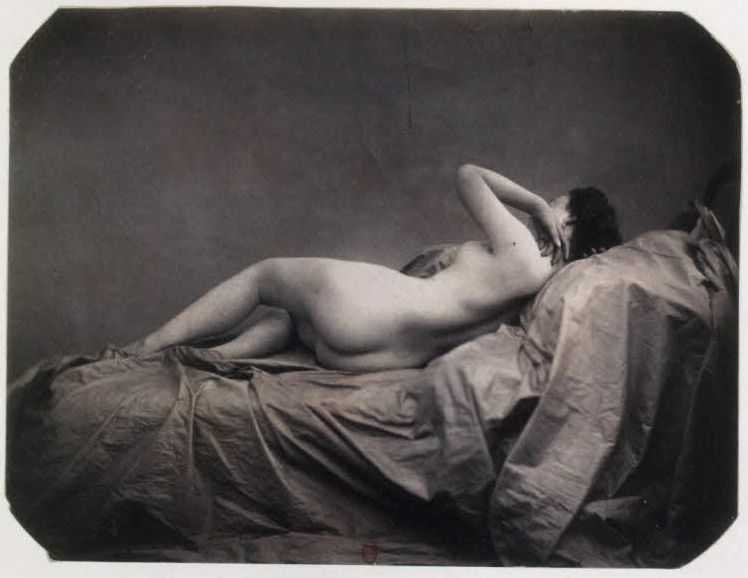
The shock of photography From its very appearance, photography inherited a long artistic tradition — and overturned it. For the photographic nude is not the painted and sculpted nude: it records a real, identifiable body, whereas painting offers only an idealized figure. Photography did not invent the scandal of the nude, but it deprived it of its alibi. The daguerreotypes by Auguste Belloc, Bruno Braquehais, and Louis Jules Duboscq, presented at the beginning of the exhibition, make this rupture palpable: beneath the conventions of the academic pose, the body imposes its presence, which resists any sublimation. This tension never ceases to renew itself — the ways of framing, of lighting, of posing, the canons that take hold and then fade, so many questions that each generation of photographers reopens and re-enacts in its own way.
Under the counter The first decades of photography were from the outset shot through with equivocal uses. Some photographers sold images clandestinely, at the risk of being prosecuted for offending public decency. Félix Moulin and Auguste Belloc, several of whose prints are shown in the exhibition, had this experience. Some prints from this period still bear, pasted onto the print itself, labels restricting their display in shop windows. The same images circulated as academic models for the fine arts, and were bought for other uses, other gazes. The boundary has always been porous. A few decades later, conditions had changed, without the resistance disappearing altogether. The luxurious journal Camera Work published nudes by Edward Steichen in the 1900s, but also by women photographers, Alice Boughton and Annie Brigman. Books of nudes entered the legitimate publishing circuit, such as Études de nu by Germaine Krull in 1931; magazines circulated freely, and exhibitions institutionalized the genre. In 1933, the first international salon of the photographic nude, organized in Paris by Daniel Masclet, brought together in particular Man Ray, Laure Albin-Guillot, and František Drtikol: the nude was recognized as a fully fledged artistic subject. Taboos do not disappear; they shift.
Unpublished bodies and bodies of work The exhibition follows a chronological thread, but lingers in each period on several facets of the subject. One of the most decisive is that of the models and their identification: Marie-Christine Roux, a figure of Parisian bohemia photographed by Félix Moulin and Félix Nadar; the beautiful Antonia, whose face appears in several studios; the restless Clara Ward; Émilienne Bouillon, photographed in autochrome by Robert Demachy; Assia, muse of the interwar period. For some of these women, clothed portraits and nude views are displayed side by side, restoring an existence that the deliberate anonymity of these images had erased.
The exhibition gives due place to the photographers who established the modern canon of the nude — Brassaï, Man Ray, Edward Weston, André Kertész — and to those who worked in their wake while bending it, Bill Brandt, Ralph Gibson, and John Coplans. But it also opens onto less expected registers: fashion and advertising, which turned the nude — notably through the lens of Helmut Newton — into an instrument of commercial seduction; documentary and images of nudists, in which the desexualized body becomes a social subject; intimate photographs, from Henri de Toulouse-Lautrec diving naked into the basin at Arcachon to Raoul Hausmann on the beach, to the secret images Pierre Louÿs devoted to Marie de Régnier. Broad space is finally given to the practice of women photographers: Laure Albin-Guillot, Rogi André, and Germaine Krull in the interwar years; Sarah Moon, Elizabeth Lennard, and many others in the following decades. The male nude runs through the exhibition as a separate thread. Present from the earliest daguerreotypes, it is nonetheless less subject to ambiguity than the female nude, produced in far greater numbers. It was at the end of the 19th century, with Wilhelm von Gloeden and Guglielmo Plüschow photographing the young men of Taormina, that an avowed eroticization asserted itself, still wrapped in references to Antiquity. With Robert Mapplethorpe, a century later, all mediation falls away: the eroticized male nude becomes the expression of a gay culture that asserts and represents itself.
From the daguerreotype to artificial intelligence Two hundred years of the nude in two hundred photographs: from the first daguerreotypes to images generated by artificial intelligence, retouched negatives, hand-colored prints, intimate albums, pin-up magazines, calendars, postcards. The exhibition reveals the extraordinary diversity of objects that two centuries of photography have produced around the nude, and the very different audiences to which they were addressed. The stereoscopic daguerreotype, sometimes heightened with color, sits alongside the luxurious plates of Camera Work, which in turn rub shoulders with prints that have been scraped and retouched, to erase hair here, to narrow the waist there. Two centuries of nude photography are two centuries of inventing devices, techniques, and processes for showing and for hiding, for legitimizing and for subverting. Where the pioneers provoked the shock of the real body, some of today's photographers confront bodies far removed from stereotypes of beauty, or even fabricate bodies that never existed — and which nonetheless inherit everything that came before.
Getting there
Source: Original page · Licence Ouverte 2.0 · Text translated or changed
