

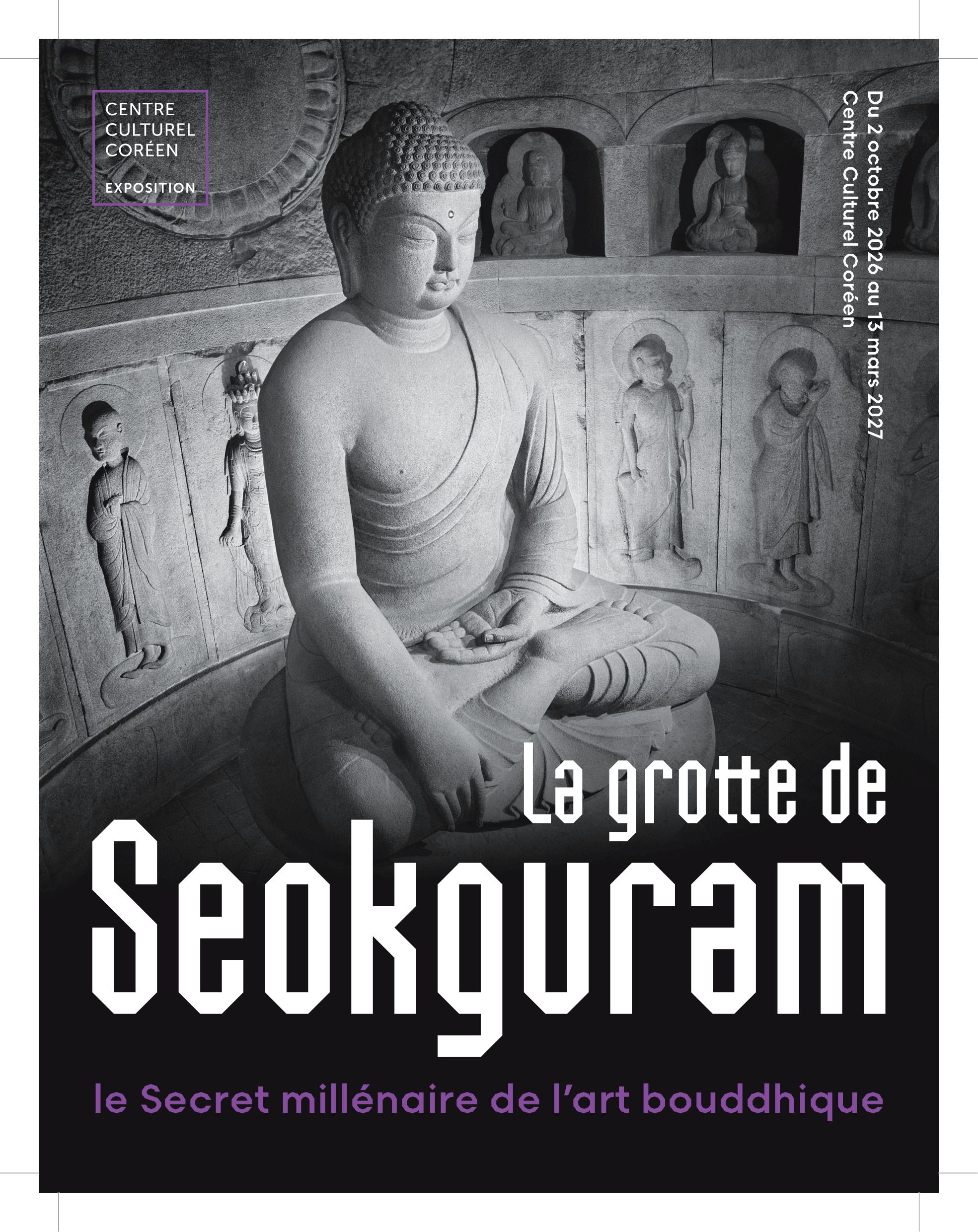
Exhibition “The Seokguram Grotto: the Millennial Secret of Buddhist Art”
Updated Nov 2026
About
To mark the 140th anniversary of diplomatic relations between Korea and France, the Korean Cultural Centre, the city of Gyeongju and Korea's National Research Institute of Cultural Heritage are presenting an exhibition devoted to the Seokguram Grotto, a UNESCO World Heritage site located in Gyeongju, the former capital of the Silla Kingdom. Through this emblematic site, the exhibition invites visitors to discover the Buddhist art that flourished during that period.
Located in the south-east of the Korean peninsula, Gyeongju was the capital of the Silla Kingdom (57 BC – AD 935) for nearly a thousand years. It is home to numerous archaeological sites and remains that bear witness to the cultural wealth and traditions of the period.
Seokguram, situated on Mount Toham in Gyeongju, is an artificial grotto built from finely carved granite blocks assembled with remarkable precision. A true masterpiece of Buddhist art from the Unified Silla Kingdom (668–935), it testifies to the artistic refinement, architectural mastery and openness to the world that characterised the period. In 1995, Seokguram was inscribed on the UNESCO World Heritage List in recognition of its outstanding heritage value.
This exhibition has been designed to offer visitors a more immersive discovery of Seokguram, a true jewel of Silla culture and a reflection of the Buddhist universe. It presents the monument's original architecture and remarkable construction techniques. Thanks to photographs by Han Seokhong, who devoted his life to capturing Korea's cultural heritage, visitors will also be able to appreciate the beauty of the sculptures that make up the grotto. Among them, statues of monks, bodhisattvas and buddhas bear witness to the sacred dimension of religious art.
The exhibition also offers an immersive, sensory experience through various digital and educational features. An LED screen allows visitors to discover the main historical sites of Gyeongju, including Bulguksa Temple and the Seokguram Grotto, while braille materials and tactile features invite visitors to apprehend the works through touch. These different approaches offer a concrete and accessible discovery of Korean cultural heritage.
The exhibition also sheds light on the Buddhist culture of the Silla Kingdom through the presentation of emblematic sites and objects. Seokguram embodies the ideal vision of the Buddhist world to which the Unified Silla Kingdom aspired; the glazed wall bricks decorated with guardian motifs from the Sacheonwangsa site evoke the protection of Buddhist Law; the pond and lotuses connect the world of the Buddha to the earthly world; as does the Great Dharani Sutra of Immaculate and Pure Light, which represents the realisation of the world of the Buddha through sacred writings.
Finally, the exhibition connects past and present through installations and works by contemporary artists who reinterpret Silla Buddhist culture and aesthetics. With Yeonji, Kim Eun-ha gives new life to pottery, fragments of roof tiles discovered in temples and recycled fibres, brought together in a poetic creation. Lee Seung-chul revisits traditional Buddhist sculpture through reproductions in hanji paper, while Sohn Dae Hyun highlights the richness of Korean craftsmanship with Buddha sculptures made using various techniques, including lacquer, ivory, mother-of-pearl and gilding. Finally, Studio Shinyoo offers a contemporary reinterpretation of the Buddhist pagoda, symbol of the Buddha's relics, the practice of the Dharma and the vows made by the faithful. Combined with objects dating from the Silla period, this installation invites visitors to linger around the works, make their own wishes and meditate.
From 23 November, a new immersive exhibition will complement the discovery of Seokguram. Through a hyper-realistic reconstruction and a mapping projection on four canvases, visitors will be able to explore the grotto virtually and discover this emblematic site from a new perspective.
Information at coree-culture.org
Getting there
Source: Original page · Licence Ouverte 2.0 · Text translated or changed
