

Photography's Conquest of the Book
Updated Nov 2026
About
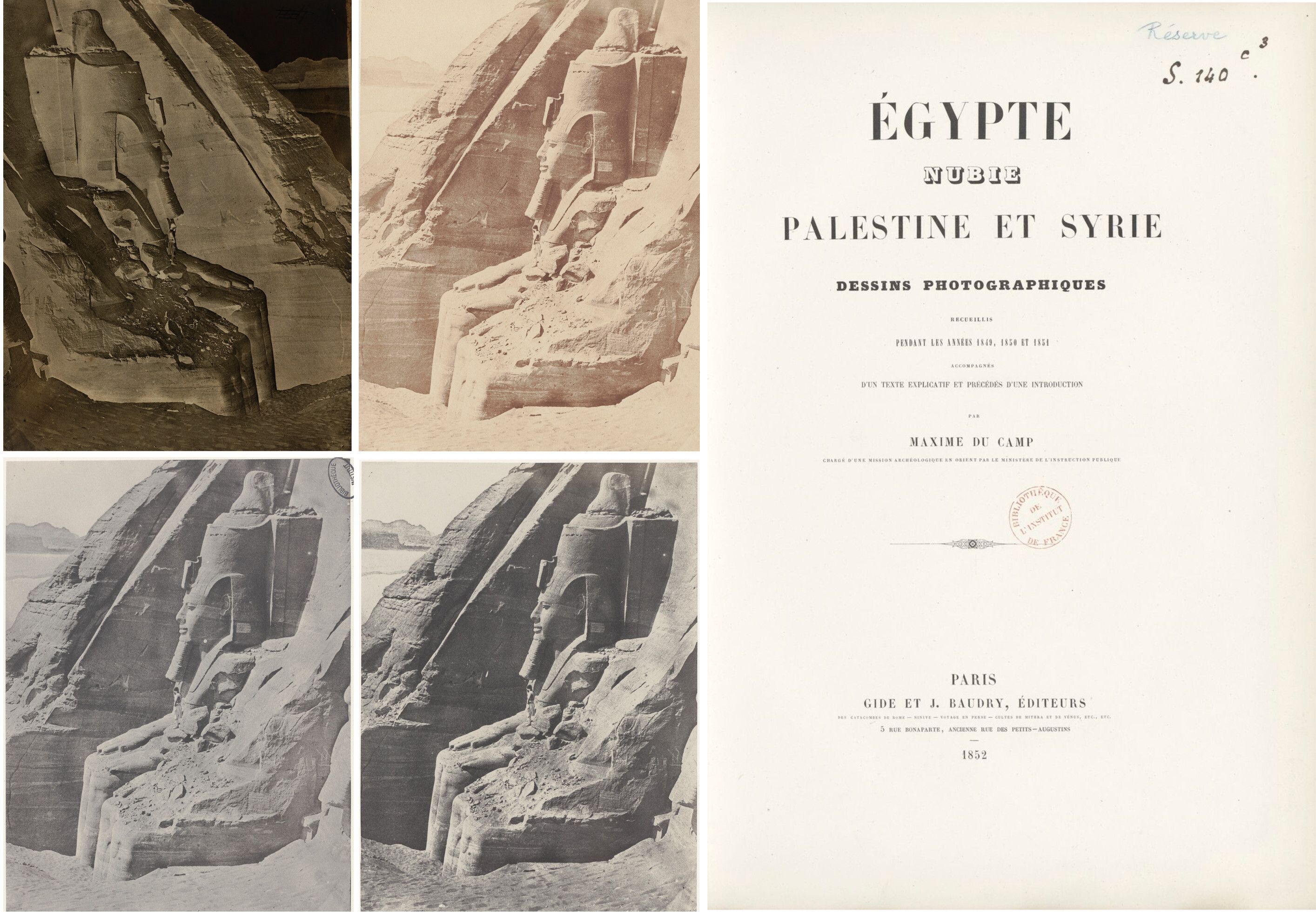
The exhibition will address one of the decisive challenges that, in the wake of the invention of photography, stimulated men of the book, men of science, and artists: How can printing and photography be made compatible? How can photography be used to illustrate books that, since Gutenberg's invention, had incorporated images previously drawn and painted, engraved on wood or copper, then lithographed? How can the initial constraint of photography be overcome (the daguerreotype is a "unitary" product) and converted to the economy of print, which rests on reproducibility, multiplicity, and the instantaneous articulation of text and image? From the very beginning of the 1840s, various technical solutions were explored and put into practice, often combined, but whose effectiveness, cost, stability, and documentary and/or aesthetic qualities were immediately assessed. The contributors to this feverish history are photographers (Nadar the younger, the Bisson brothers...), opticians (Noël Lerebours...), publishers (Baillière, Didot...), lithographers (Lemercier...), painters (Achille Deveria...), chemists (Blanquart-Évrard, Niepce de Saint-Victor...), engineers (Eugène de Gayffier), but also archaeologists (Lottin de Laval, Charnay, Prisse d'Avennes...), astronomers (Amédée Guillemin), physicians (Duchenne...), botanists (Emile Levier...) and zoologists (Louis Rousseau), who glimpsed the benefits these investigations represented for their disciplines. This research gave rise to books that were sometimes luxurious and monumental - so much so that the public authorities, especially from the Second Empire onward, judged it essential to support them - sometimes unfinished, sometimes technically mysterious. Some of these incunabula of photography are the fruit of ephemeral inventions, quickly abandoned for their cost or technical complexity, but most illustrate a movement that, initiated in 1844 by Noël Lerebours's Excursions daguerriennes (the very year Fox Talbot's Pencil of Nature appeared), leads up to the 1880s with not only the spread of instantaneous photography (the gelatin silver bromide negative, preparable in advance, industrializable, and requiring short exposure, replacing the collodion technique), and above all the development of halftone photographs, which could be printed in relief at the same time as the text. This culmination marks photography's conversion to typography. The exhibition will draw on the exceptional collection of books illustrated by photography held by the Mazarine and Institute libraries, supplemented as necessary by a few outside loans (archives of the Academy of Sciences, the Academy of Fine Arts, the Sainte-Geneviève library). Centered on French production, it will be able to assemble 50 items (more if we decide to extend the chronological limit beyond 1884, up to the early twentieth century). The technical questions of the conversion/transposition/adaptation of the photographic image to the world of publishing, with or without the intermediary of engraving, will serve as a guiding thread: mounting of pasted-down photographic prints, transposition of photographic images onto steel plates subsequently engraved in aquatint, photolithography, phototypy, heliographic damascening, photoglypty... up to the triumph of halftone engraving, which prevailed in the 1880s and temporarily marked the conversion of photography to typography... before the beginnings of offset printing, in the following century, reversed this dynamic. But the exhibition will also draw attention to four other aspects: - the way in which the book illustrated by photography, by serving the desires of artists (Louis-Auguste Martin's Promenades poétiques et daguerriennes in 1850; the first photographic facsimiles of prints with Charles Blanc and the Bisson brothers, Œuvre de Rembrandt reproduit par la photographie, 1853-1858; Le Tour de Marne, published in 1865 by Émile de La Bédollière and Ildefonse Rousset...) contributes to legitimizing photography as an art, contrary to the famous stance taken by Baudelaire at the Salon of 1859. - the way in which the book integrates the "photographic document" into scholarly or pedagogical apparatuses, particularly in the fields of archaeology, astronomy, the life sciences, and medicine (Alfred Donné, Cours de microscopie, 1844-1845 [first publication of photomicrographic reproductions]; Album de photographie pathologique by Dr. Duchenne in 1862...). - the adaptation to the periodical press of a portion of these technical innovations. Attention will be drawn to the fact that from the very year of its creation, the weekly L'Illustration (1843) incorporated an image produced by the new process (in fact a wood engraving obtained from a daguerreotype). - the way in which these technical efforts and experiments mobilized society and the public authorities (cf. the competition founded by the Duke of Luynes in 1856, which was to reward the inventor who, within the space of three years, would have found a means of having images obtained by photography reproduced directly by printing (relief printing) or lithography (planographic printing)).
Getting there
Source: Original page · Licence Ouverte 2.0 · Text translated or changed
