

Silent Violence. Under the Gaze of Roméo Mivekannin
Updated Nov 2026
About
Exhibition Silent Violence. Invitation to Roméo Mivekannin From November 10, 2026 to April 4, 2027
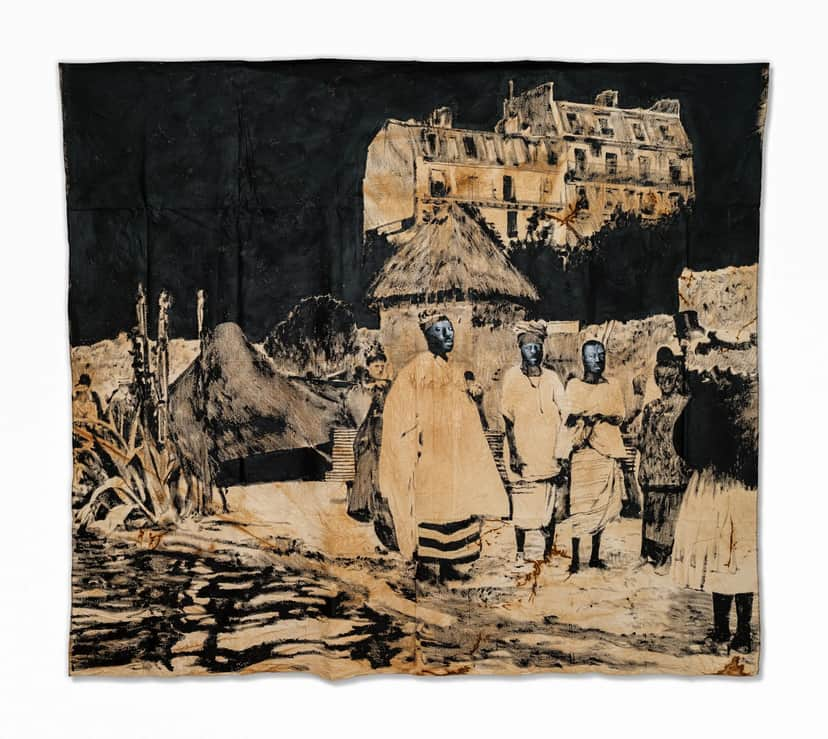
Born in Bouaké (Côte d'Ivoire) in 1986, Beninese artist Roméo Mivekannin develops a body of work that critically interrogates colonial history and the mechanisms of representation of Black bodies in Europe. Now living and working in Toulouse, he was first exhibited there at FRAC Occitanie – Les Abattoirs in the late 2010s. His work, primarily pictorial, combines acrylic paint and a brown-mud elixir applied onto French cotton cloth. Drawing on paintings and photographs produced by Europeans, the artist revisits Black models and regularly inserts himself into the scenes depicted through self-portraiture. The exhibition offers the public a critical journey through the ethnographic exhibitions of the 19th and 20th centuries, also referred to today as "human zoos," during which non-European objects and people were displaced and stripped of their status to become curiosities subjected to the Western gaze. Taking Paris and its emblematic sites as his anchor, Roméo Mivekannin interrogates both the colonial legacy of museum institutions and the silent violence contained within the images of these human stagings. For this exhibition, the artist has conceived an unprecedented ensemble composed of four metal sculptures, fourteen large-format paintings, and one ceramic work. The sculptures, produced by Ivorian blacksmiths in Abidjan following the artist's instructions, take the form of closed aviaries with no opening. They reproduce, at reduced scale, the founding buildings of the musée du quai Branly – Jacques Chirac and its predecessor institutions. This installation evokes the symbolic and material confinement inherent to certain museum practices, inviting visitors to take a critical look at the history of the exhibition venues themselves. The central sequence of the exhibition consists of fourteen canvases paired with photographs and original glass plates drawn from the collections of the musée du quai Branly – Jacques Chirac. Through self-portraiture, the artist inserts himself into the scenes of ethnographic exhibitions at the Champ-de-Mars, the Jardin d'Acclimatation, or the Folies Bergère. The scenographic installation will directly engage the public: the original images reveal themselves only on request, in a play of reflections in which the visitor sees themselves looking, becoming in turn an actor in the mechanism of viewing and questioning.
Getting there
Source: Original page · Licence Ouverte 2.0 · Text translated or changed
