

Stockholm for first-time visitors: islands, transport, weather and food
Stockholm guide · Last checked Nov 24, 2026
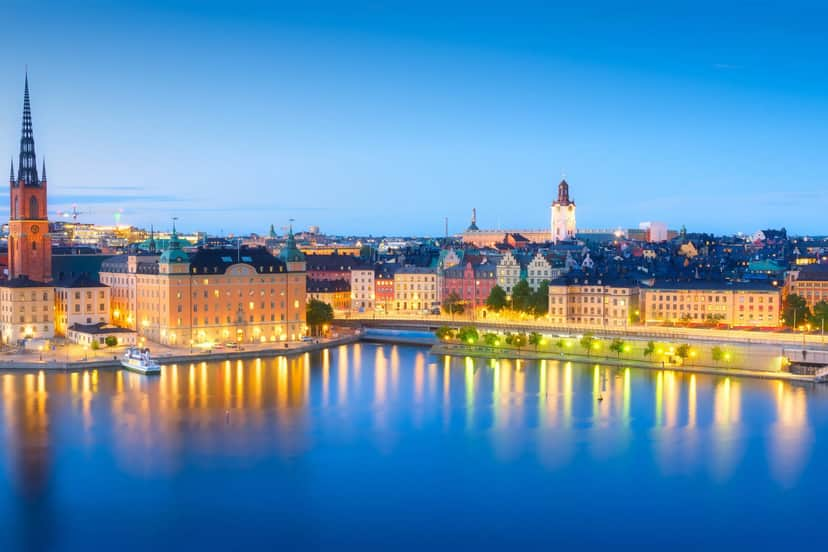
Stockholm's centre sits on 14 islands joined by bridges, where Lake Mälaren empties into the Baltic. Water covers more than 30% of the city and green space as much again. You can swim in the lake.
Arriving
There are four airports. Arlanda, Sweden's biggest, is about 40 km north; the Arlanda Express train gets to Stockholm Central Station in 20 minutes. Bromma is about 8 km west. Skavsta, 108 km south, and Västerås, 103 km west, handle international flights only. Flygbussarna coaches run from central Stockholm to all four.
Which district is which
Most sights are in the inner city, while most residents live in suburbs spread over Stockholm County. The inner districts to know:
- Gamla Stan, the Old Town, on the central islands: cobbled lanes on a medieval plan.
- Norrmalm, just north of it: Sweden's largest shopping district, around the square Sergels torg.
- Vasastan, north of Norrmalm: apartment blocks and local cafés.
- Östermalm, east of the centre: 19th-century stone buildings and waterside walks.
- Kungsholmen, an island west of Norrmalm, with the City Hall on its eastern end.
- Södermalm, just south of Gamla Stan: large, hilly and mostly residential.
- Djurgården, an island east of the centre: parkland and big museums, the Vasa Museum among them.
- Hammarby Sjöstad, south-east of Södermalm: a modern, eco-minded district on the water.
History you can walk through
Birger Jarl founded the city in 1252, and Gamla Stan grew on its central island from the mid-13th century. Its old square, Stortorget, is linked to the Stockholm Bloodbath of 1520, when the Kalmar Union king Christian II had his opponents killed. Stockholm Palace, at Gamla Stan's edge, is still the monarch's official home. Riddarholmen Church, on the neighbouring islet, dates in part to the late 13th century, making it one of the oldest buildings in the city, and Swedish monarchs are buried there. The Nobel Prize ceremonies take place at the Concert Hall and the City Hall, and the city has about 100 museums.
Weather through the year
June and early July get about 18 hours of daylight, and from late May to mid-July the night sky never turns fully dark. Summer afternoons average 20 to 25 °C; 25 to 30 °C is fairly common in July and August.
By late December daylight is down to about six hours. Winter averages sit around 0 °C, and the wettest months come in summer, June to August. Snow falls mainly from November to March, now and then in late October or April, and lies on 75 to 100 days in an average year, but the amount swings widely between winters, so no date is certain. For a sure Scandinavian winter, go to Dalarna or Norrland. Spring and autumn are cool to mild. Sunshine averages 1,900 hours a year.
Getting around by public transport
Storstockholms Lokaltrafik, SL for short, runs nearly all public transport in the county on a single ticket system. Pay by tapping a contactless card or phone, or in the SL app. A single ticket lasts 75 minutes on any mode; travel cards last anywhere from 24 hours to a year.
Swedes call the metro Tunnelbana or T-bana; signs show a T. It has seven lines in three colours (green, red, blue) and about 100 stations covering the centre and many nearer suburbs, and nearly every station holds artwork: mosaics, sculpture, painted rock.
Commuter trains, pendeltåg, run four lines to 54 stations, marked with a J; they reach Uppsala, Knivsta, Bålsta and Gnesta beyond the county line. Buses serve the areas rail misses.
Trams and ferries
SL runs four tram and light-rail lines:
- Spårväg City, line 7, from T-Centralen across Norrmalm and Östermalm to Waldemarsudde on Djurgården.
- Lidingöbanan, from Ropsten in Östermalm to the island of Lidingö.
- Nockebybanan, from Nockeby to Alvik on the metro's green line.
- Tvärbanan, connecting southern suburbs.
SL ferries take SL tickets; line 82 crosses from Slussen to Djurgården, and boats also serve Skeppsholmen. Waxholmsbolaget's boats for the outer archipelago leave Strömkajen and need separate tickets.
On foot and by bike
Gamla Stan, Norrmalm, Södermalm and Kungsholmen are an easy walk apart over the bridges, best without snow underfoot. Watch for silent e-bikes and e-scooters. Bike lanes (cykelbanor) line most main streets; ice makes winter riding risky. Voi and Bolt rent e-scooters through their apps.
Coffee, meals and cooking
Fika is the Swedish coffee break with a pastry, classically a kanelbulle (cinnamon bun), often taken several times a day; coffee bars are all over town. On weekdays many restaurants offer a dagens rätt, a set lunch dish.
Nordic cooking rests on fish and meat: herring, salmon, meatballs with lingonberries, potatoes. Husmanskost is everyday Swedish home food, and vegetarian and vegan food is easy to get. Den Gyldene Freden in Gamla Stan has kept one address since 1722. Many restaurants take a summer break of some weeks, in July or into early August; check first. Self-caterers can shop at ICA, Coop and Hemköp.
Paying and buying drinks
Carry a card. Many shops, cafés and kiosks take no cash, and Swish, the phone payment app, is for residents only. Drinks over 3.5% alcohol are sold only at Systembolaget, the state chain, never in supermarkets; bars and restaurants serve under their own licences.
Photo and data credits
Frequently asked questions
How many islands is central Stockholm built on?
The inner city spans 14 islands across Lake Mälaren and three streams into the Baltic Sea.
What is the Tunnelbana in Stockholm?
It is the city's rapid transit system, shortened to T-bana or T on signs. Its 100 stations serve most of the inner city and many inner suburbs.
Is Stockholm easy to walk around?
Walking in the inner city is easiest when there is no snow. The suburbs are rather spread out.
Does it snow in Stockholm?
Snow can fall from late November to early April, but amounts vary greatly from year to year. No date is a safe bet.
What is fika?
Fika is the Swedish tradition of a break for coffee and a biscuit, and coffee bars are found around the city.
Do I need cash in Stockholm?
Sweden is largely card-oriented, and quite a few smaller venues do not accept cash.
