

Sydney cultural venue history: four rooms
Sydney guide · Last checked Nov 24, 2026
The Utzon Room opened in 2004 as the first interior at the Sydney Opera House finished entirely to Jørn Utzon's own specifications. In the Concert Hall, the architects of the latest renewal found brush box and white birch from the original build stored inside the hall, and put that timber back to work. City Recital Hall, which opened in 1999, was Sydney's first purpose-built music venue since the Opera House. Carriageworks was the Eveleigh carriage workshops of the NSW Government Railways until they shut in 1989.
Utzon Room, Sydney Opera House
The concrete beams across the ceiling hold up the Monumental Steps, and Utzon credited them to the engineer Ove Arup, calling them 'Ove's invention'. The Opera House treats them as the surviving mark of a partnership between the two men that later fell apart.
Before the renovation this was the Reception Hall. The finished room was opened by Utzon's daughter Lin and the NSW Premier, Bob Carr.
The west wall carries a woven piece Utzon designed and named himself, 'Homage to Carl Philipp Emanuel Bach'. The piece runs about 14 metres and stands 2.67 metres tall. At that length it had to be woven sideways, which Pamela Joyce, Chris Cochius, Cheryl Thornton and Milena Paplinska did in Melbourne in 2003. The four of them spent eight months on it and got through 4,500 km of Australian wool. It weighs 120 kg, and because wool soaks up sound, it improves how the room sounds as well.
Across from the tapestry is a wall of glass looking out over the harbour. About 200 people fit. The room's main public series, Utzon Music, is chamber music on Sunday afternoons, programmed by the recorder player Genevieve Lacey, with the water behind the musicians.
Address: Sydney Opera House, Bennelong Point, Sydney NSW 2000, Sydney
Prams, umbrellas, backpacks and large bags go to the cloakroom; latecomers can be held until a break in the music, and every child aged 3 or over needs a ticket.
Concert Hall, Sydney Opera House
Ronald Sharp's Grand Organ is built into the southern wall, with 10,244 pipes ranging from 9.7 metres long down to 5 mm. Sharp, a Sydney organ builder, worked on it for more than ten years, some of that time in a small factory in Mortdale, and completed it in 1979. During the renewal it was shielded and left alone, so the instrument rising above the choir stalls is still the one he built.
After Utzon left the project in 1966, the interior went to Peter Hall, and the hall opened in 1973. Walls, stage and floor are Australian brush box; the ceiling is faced in white birch veneer; every seat is a birch shell covered in magenta wool. When ARM Architecture renewed the hall, some of the brush box and birch they used was original stock that had sat in storage inside the building.
Overhead is where the hall has changed most. For decades clear acrylic rings, nicknamed 'doughnuts', made by the Sydney firm K. F. Plastics, hung above the stage, and they were swapped for near-copies several times. Eighteen petal-shaped reflectors in semi-gloss magenta took their place. They can be moved to suit whatever is being played.
Orchestras are only part of it: a dance school's national finals, a girls' choir and films screened with the Sydney Symphony playing the score have all appeared on its listings.
Address: Sydney Opera House, Bennelong Point, Sydney NSW 2000, Sydney Getting there: next door to the Utzon Room.
A lift and passageway added in the renewal reach every level for wheelchair users, and there are twice as many accessible seating positions as before.
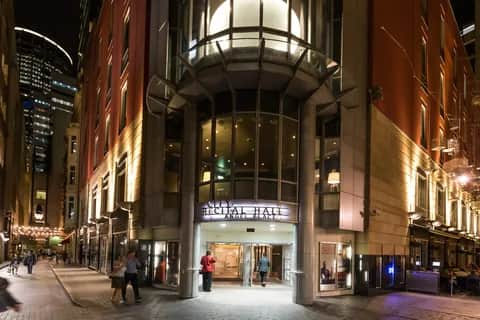
City Recital Hall
Railway vibration at Angel Place was bad enough that the entire auditorium had to be floated on rubber pads made for the job. The Tank Stream runs through the basement.
It opened on 30 October 1999, Sydney's first purpose-built music venue since the Opera House. Two previous attempts to establish a similar facility failed. A hall drawn into Andrew Andersons's 1992 scheme for the 'Toaster' building at East Circular Quay was dropped for cost, and the idea of fitting one inside Customs House was argued over from 1992 to 1994 with nothing workable in the end. What finally worked was a deal between the City of Sydney and AMP, under which the lower floors of AMP's new Angel Place tower were kept for a concert hall. After long talks, some of them about parking in that tower, the city got the hall on a 99-year lease at a token rent. The aim was a mid-sized room with fine acoustics that concert producers could afford to hire.
The room is a shoebox, the shape European concert halls took in the 19th century, with gently raked stalls and two galleries running around the sides and back. Gold leaf against grey walls, pale timber panels, plum seats. A main stair in white marble. It was designed for the roughly 1.8 seconds of reverberation that chamber music needs, and both the Australian Chamber Orchestra and Musica Viva treat it as their Sydney home.
Address: 2 Angel Place, Sydney Getting there: about a 22-minute walk from the Concert Hall.
Tickets are non-refundable. Anything bigger than a standard handbag is checked at the Entry Level cloakroom, and there is a dress code only if the event sets one.
Carriageworks
The entry structure on Wilson Street is made of the workshop's original wrought-iron roof trusses, pulled out of Bay 17 to give the big theatre its height and reused upside down.
Eveleigh's carriage workshops went up in 1888, built by the NSW Government Railways, and stayed in use from 1889 until they shut in September 1989. The work here was fixing passenger carriages, both suburban and long-distance. Several thousand people worked on the site in the 1900s. Carriageworks' own history places the start of the 1917 Great Strike inside these walls, with thousands of workers marching on NSW Parliament.
In June 2002, the site passed to the state's arts ministry. Tonkin Zulaikha Greer converted it between 2003 and 2007. In 2008 the conversion took an Architecture Award from the Australian Institute of Architects, and a Greenway Award for its handling of the heritage fabric. The raised roof traces the ridges that once stood up along the top of the old workshop roof, and the three theatres stand free of the preserved structure, so the old building stays visible in the gaps between them.
A farmers market has traded here every week since 2009.
Address: 245 Wilson St, Eveleigh, Sydney Getting there: about 55 minutes on foot from City Recital Hall, far enough that a taxi or public transport is easier; Redfern Station is an 8-minute walk away.
There is no public parking on site; the car park has three mobility parking spaces. Level access across the precinct and a street ramp to the main entrance; no hearing loop. The site is wheelchair accessible.
At Eveleigh, the railway has not entirely gone, either: the eastern end of the old workshops is where Transport for NSW keeps part of its heritage fleet.
In this guide
Railway vibration at Angel Place was bad enough that the entire auditorium had to be floated on rubber pads made for the job. The Tank Stream runs through the basement. It opened on 30 October 1999, Sydney's first purpose-built music venue since the Opera House. Two previous attempts to establish a similar facility failed. A hall drawn into Andrew Andersons's 1992 scheme for the 'Toaster' building at East Circular Quay was dropped for cost, and the idea of fitting one inside Customs House was argued over from 1992 to 1994 with nothing workable in the end. What finally worked was a deal between the City of Sydney and AMP, under which the lower floors of AMP's new Angel Place tower were kept for a concert hall. After long talks, some of them about parking in that tower, the city got the hall on a 99-year lease at a token rent. The aim was a mid-sized room with fine acoustics that concert producers could afford to hire. The room is a shoebox, the shape European concert halls took in the 19th century, with gently raked stalls and two galleries running around the sides and back. Gold leaf against grey walls, pale timber panels, plum seats. A main stair in white marble. It was designed for the roughly 1.8 seconds of reverberation that chamber music needs, and both the Australian Chamber Orchestra and Musica Viva treat it as their Sydney home. Tickets are non-refundable. Anything bigger than a standard handbag is checked at the Entry Level cloakroom, and there is a dress code only if the event sets one.
Photo and data credits
Frequently asked questions
What was Carriageworks before it was an arts centre?
It was the Eveleigh Carriage Workshops, built in 1888 by the NSW Government Railways, where passenger carriages were repaired until the site closed in September 1989. Tonkin Zulaikha Greer converted it between 2003 and 2007.
Why is the Utzon Room named after Jørn Utzon?
It was the first interior at the Sydney Opera House completed entirely to Utzon's own specifications. It was the Reception Hall before that, and it opened in its current form in 2004.
What hangs on the wall of the Utzon Room?
A woven wool piece Utzon designed, 'Homage to Carl Philipp Emanuel Bach', about 14 metres long. Four weavers in Melbourne made it on its side in 2003, over eight months, and it helps the room's acoustics.
Who designed the interior of the Sydney Opera House Concert Hall?
Peter Hall, after Utzon left the project in 1966. The hall opened in 1973 with brush box walls and floor, a white birch ceiling and magenta wool seats.
When did City Recital Hall open?
On 30 October 1999, as Sydney's first purpose-built music venue since the Opera House. Earlier plans for a recital hall in the 'Toaster' building and Customs House had both fallen through.
Why does City Recital Hall sit on rubber pads?
Railway vibration at the Angel Place site meant the whole auditorium had to be floated on purpose-built rubber pads. The Tank Stream also runs through the basement.
