

Alfama on Foot: From the Sé to São Jorge Castle
Lisbon guide · Last checked Nov 25, 2026
Alfama is the oldest district in Lisbon. It covers the hillside below the Castle of São Jorge, falling south to the River Tagus, and its name comes from the Arabic al-hamma, meaning fountains or baths. The 1755 earthquake did great damage across the capital, but this tight maze of narrow streets and small squares came through it with little harm.
This route climbs that slope from the river to the castle. On the way it passes the cathedral, the church built where Saint Anthony is believed to have been born, a Roman theatre, a detour down to the fado museum and two viewpoints. The distances between stops are short; the hills and the time spent inside are what fill the day, so set aside half of one.
Before you set out: wear flat shoes with a good grip, since the way is stairs and cobbles from start to finish, and leave the pushchair or the wheeled case behind. Lisbon's summers are hot and dry, and the kinder seasons for all this climbing are spring, from March to May, and autumn, from September to October. If you do come in summer, start early.
Start at Terreiro do Paço
Take the metro to Terreiro do Paço station, on the Blue line, and come up at Cais da Alfândega. The great square by the river has no shade at all and bakes on a summer afternoon, so do not linger there. The first stretch is level, then the street begins a gentle rise.
Next stop, the Sé: 490 m, roughly 7 min on foot.
The Sé
Lisbon Cathedral was begun in 1147 under Afonso Henriques, once the city had been conquered. The first building was Romanesque: a Latin cross with three naves. The cathedral calls itself the oldest church in Lisbon. King Dinis started the Gothic cloister.
In 1755 the earthquake brought down part of the building, the Gothic chancel and a tower among it. A restoration in the early 1900s stripped off the Baroque additions and left the neo-Romanesque church you see today. It became a Monumento Nacional in 1910 and was reopened in 1940. Since 1990, excavations beneath the cloister have turned up Roman remains, Visigothic buildings and what is left of a mosque. The relics of Saint Vincent of Saragossa, patron of the Lisbon diocese and the city's patron until Saint Anthony replaced him in the 1980s, are kept in the Sé.
The church and the cloister have separate queues. The 28E tram squeezes along the narrow street right outside the door, and the pavement jams when it passes. When this was written, the Sé opened Monday to Saturday, with Sundays and holy days closed; the cathedral's own pages give two different timetables, so check before you go. Plan 40 minutes inside, or 10 for a look from the square.
Next stop, the Igreja de Santo António: 145 m, roughly 2 min on foot.
Santo António and the Roman Theatre
The Igreja de Santo António stands on Largo de Santo António da Sé, on the spot where Saint Anthony is believed to have been born. Lisbon keeps his holiday on 13 June, and Alfama marks it with the Festas de Santo António, street parties with music and food. Visitors often take the church for part of the cathedral; it is a separate building. King João II built a chapel here in the mid-15th century. The Baroque church you see went up in the 1760s, after the earthquake destroyed the one before it. The Museu de Lisboa - Santo António, a small branch of the city museum, is next door. Ten minutes for the church; half an hour with the museum.
Next stop, the Roman Theatre: 380 m, roughly 5 min on foot, climbing through the lanes.
The Museu de Lisboa - Teatro Romano, at Rua de São Mamede 3A, is hidden down quiet alleys, so follow a map. The Romans built the theatre in the reign of Augustus. It was given up in the 4th century AD and lay buried until 1798, and the ruins on show were found under the debris of the 1755 earthquake. You can still trace the stage and the orchestra, and a good part of the seating. Entry is free with the Lisboa Card; check its hours and price first. Allow 30 minutes.
Next stop, the Museu do Fado: 548 m, roughly 7 min on foot, dropping through steep lanes to Chafariz de Dentro.
Down to the Museu do Fado
Fado, Portugal's melancholy song, is part of Alfama: you will hear it in some of the district's restaurants and bars. The Museu do Fado, at Largo do Chafariz de Dentro 1, occupies an old water pumping station, built from 1868 on. When this was written it opened Tuesday to Sunday 10:00-18:00, last entry 17:30. Give it an hour, or walk past if time is short.
Going down here takes you almost to river level, and everything after it is uphill.
Next stop, the Miradouro de Santa Luzia: 374 m, roughly 5 min on foot, and steep, with about 45 m to climb.
Santa Luzia and Portas do Sol
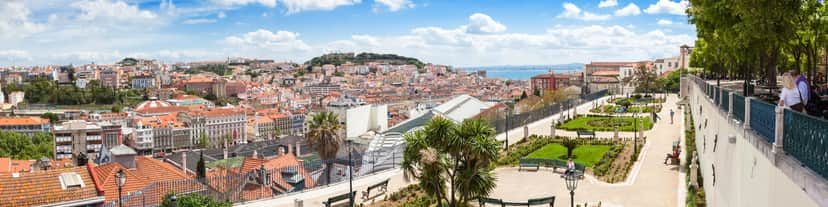
The Miradouro de Santa Luzia is a viewpoint next to the church of Santa Luzia e São Brás, with a garden, a pond, a pergola of bougainvillea and trams going by. It is small and fills up fast. Its tiles, by António Quaresma, picture Praça do Comércio in the years before 1755 and the capture of the castle from the Moors. Across the roofs, find Santa Engrácia by its dome, then Santo Estevão, then São Miguel with its two towers. Ten minutes is enough.
Next stop, Largo das Portas do Sol: 86 m, roughly 1 min on foot.
Largo das Portas do Sol is named after the Porta do Sol, a gate in the medieval Moorish wall that the 1755 earthquake destroyed. It looks out over the Tagus and the rooftops of Alfama. Tour groups and street performers crowd it around midday.
The Museum of Portuguese Decorative Arts is at number 2. Ricardo do Espírito Santo Silva set up the foundation that runs it, the Fundação Ricardo do Espírito Santo Silva, in 1953, and it also holds workshops in the arts and crafts. Ten minutes from outside, or 45 inside.
Next stop, the Castelo de São Jorge: 420 m, roughly 6 min on foot, all uphill.
Castelo de São Jorge
The castle site has been lived in without a break for some 3,000 years. The castle's history page suggests the Iron Age settlement spread over both its north and south sides. An inscription dated 985 credits Almanzor with work on the city's defences, and the earliest mention of a castle inside the walled citadel dates from the 13th century, under Afonso III and Dinis. In 1147 the castle fell to Afonso Henriques. The 1755 earthquake hit the castle and the palace hard.
The last stretch is steep and the old paving stones are uneven. Buy your ticket in advance to skip the ticket-office line at the gate; at midday the security queue is long even with a ticket in hand. When this was written, the castle opened 9:00-21:00 between March and October, with 20:30 the last entry, and 9:00-18:00 between November and February. In summer the towers and the walk along the walls may close between 18:00 and 21:00, and the castle museum is shut for now while its toilets are upgraded. Allow 90 minutes.
The walk at a glance
- Begin: by Terreiro do Paço station, Blue line.
- Finish: Castelo de São Jorge. To get back on the metro, Martim Moniz (Green line) is 1,206 m away, around 16 min; Santa Apolónia (Blue line, plus the train station) is 1,412 m, around 19 min.
- Time on foot: 26 min stop to stop, 6.6 min from the first station and 16 min to the last: about 49 min in all.
- Time at the stops: 250 min if you enter every one.
- Time overall: about 3 h 30 min if you skip the Fado Museum, the inside of the Roman Theatre and the museum of decorative arts; about 6 h with everything.
- Steep sections: Roman Theatre down past the Museu do Fado and up to Santa Luzia; then Santa Luzia and Portas do Sol up to the castle.
- When this was written, the Metro ran daily 06:30-01:00.
